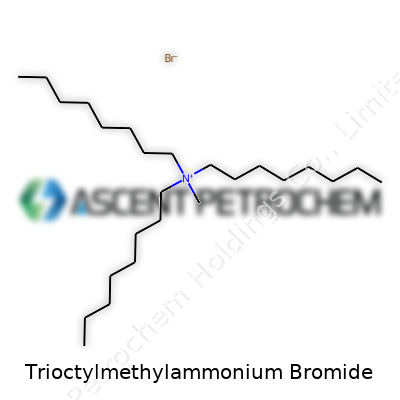
Chemists have been working with quaternary ammonium salts for decades, and trioctylmethylammonium bromide came on the scene as researchers looked for better phase transfer catalysts. Back in the 1970s, organic synthesis hit a wall with many reactions grinding to a halt when oil and water just wouldn’t mix. Early experiments with this compound in Europe and North America carved out a path for efficient ion transfer across immiscible phases. As laboratories tackled bigger and more complex organic molecules, the need for robust and versatile phase transfer agents nudged trioctylmethylammonium bromide from a curiosity to a staple. The formation of this compound matched a growing demand for selective and adaptable chemical tools, especially in pharmaceuticals and polymer science.
Trioctylmethylammonium bromide, often referred to as TOMAB, stands out because of its bulky hydrophobic chains and positive charge. Typical suppliers sell this compound as a waxy or oily solid, light yellow in color and a bit sticky to the touch. I've noticed its versatility both in benchwork and industry, cementing its role in catalyzing reactions that stray from straightforward solvents and tap into more complex, multi-phase systems. You see TOMAB used in gram-scale research, but scaling up to hundreds of liters doesn't pose major hurdles provided handling protocols are tight.
TOMAB features a substantial structure, sporting three eight-carbon octyl groups and a single methyl group bonded to a central nitrogen. The bromide counterion gives it ionic character. Its molecular formula, C25H54BrN, leads to a molecular weight around 448.6 g/mol. Melting point sits between 28°C and 30°C, which puts it just above room temperature—a detail I’ve come to appreciate when weighing out exact quantities during sticky summer science. It dissolves easily in organic solvents like chloroform, dichloromethane, and benzene but refuses to blend smoothly into water. This separation between phases, ironically, is what makes it invaluable as a phase transfer catalyst. In air, it's stable under proper storage, but heat and light can slowly darken the product over time.
Lab supply catalogs describe TOMAB with tight purity standards, typically 98% or greater. Identification happens through both physical metrics and high-performance liquid chromatography (HPLC) fingerprints. Packaging labels include hazard statements covering irritant properties, along with proper UN codes for transport. Users run into the same precautions they’d expect with quaternary ammonium compounds—gloves, goggles, and fume hoods remain non-negotiable. Chemical inventory systems now tie every bottle to its batch, storage history, and regulatory paperwork. This practicality ensures traceability—a key concern as more countries demand chemical use transparency.
Chemists usually bring together trioctylamine with methyl bromide to form TOMAB in a classic quaternization reaction. The amine dissolves in an organic solvent like toluene or acetonitrile, and a steady flow of methyl bromide finishes the job. The final product precipitates or oil out, gets washed, then dried under reduced pressure to take away any leftover methylating agent. Labs typically run this under anhydrous conditions to dodge side reactions and ensure yields stay high. A trained eye can usually catch completion by thin layer chromatography or by looking for the near disappearance of starting amine on an NMR spectrum.
TOMAB features prominently in reactions needing strong phase transfer, like nucleophilic substitutions and some carbon–carbon bond formations. Its bulk prevents tight packing with lots of counterions, making it easier for ions to jump between non-miscible phases. One of my college lab rotations focused on tweaking the side chains to shift solubility or change catalytic result. Swapping out octyl for hexyl or even butyl chains would flip the solubility profile and push reaction rates up or down. TOMAB also survives mild reduction and oxidation, so it works well with both base-sensitive and acid-labile substrates. The key pitfall is exposure to strong bases over longer periods—alkylation near the quaternary nitrogen leads to breakdown and complicates downstream purification.
On chemical ordering websites and in technical journals, TOMAB might appear as trioctyl(methyl)ammonium bromide, methyltrioctylammonium bromide, or even by older commercial tags like Aliquat 336 bromide. CAS numbers (e.g., 5137-55-3) help cut through the name maze, though many suppliers mix up nomenclature. Cross-checking with chemical identifiers such as InChI or SMILES has become the gold standard for researchers dealing with highly regulated or dual-use substances. With a growing ecosystem of phased-out and generic brands, users find double-checking the paperwork goes a long way towards reproducibility and lab safety.
Handling TOMAB demands a solid grasp of chemical hygiene. Skin and eye irritation hit first—I've seen red, itchy hands after accidents when gloves didn't fit right or labmates ditched their PPE in a hurry. Inhalation causes throat and lung irritation, so fume hood work is the norm wherever dust or vapor could be an issue. Storage means cool, dry, sealed containers away from acids, alkalis, and oxidizers. Disposal means working with licensed chemical waste handlers, especially in places like Europe and California with tough environmental controls. Workplace safety training drills often include TOMAB as a textbook example of why respect for Material Safety Data Sheets (MSDS) saves more than just paperwork.
Industries ranging from pharmaceuticals to polymers rely on TOMAB. I’ve seen it speed up esterification and alkylation reactions, helping drug manufacturers cut down process time. Its power as a phase transfer catalyst means it gets deployed to push stubborn anions and cations across liquid-liquid boundaries; this is crucial for both organic and aqueous chemistry. Polymer chemists use TOMAB to create ion-exchange membranes and specialty plastics for water treatment applications. Another area: analytical chemistry, where its surfactant properties help in sample preparation for chromatography. My time handling environmental testing kits showed how TOMAB improved extraction efficiency for trace pollutants. Its flexibility in breaking down tough boundaries makes it an unsung hero in both small and large-scale production.
Academic and industrial labs keep pushing TOMAB into new territory. Research teams explore it in green chemistry, looking for ways to conduct old reactions in water with less toxic solvents. Combining TOMAB with microwaves or ultrasonic energy shaves hours off synthetic routes, offering a nod toward sustainable chemistry. Polymer researchers are now modifying TOMAB to build designer ion-exchange resins, opening doors for energy storage and water purification technologies. In the last few years, I’ve noticed more peer-reviewed journals reporting on TOMAB’s role in halide extraction processes tied to critical battery recycling. As researchers face tougher regulations and supply chain constraints, tweaking TOMAB structure looks set to cut costs and improve yields for specialty manufacturing.
Toxicologists have laid bare the risks of TOMAB. Acute exposure usually causes irritation, but lab animal studies flag possible long-term health effects, especially to aquatic environments. Reports show that TOMAB lingers in waterways longer than one might hope, and fish and invertebrates show sensitivity at concentrations below 1 milligram per liter. Repeated skin exposure increases sensitization risk, and there is ongoing debate about bioaccumulation in food chains. Human health impacts remain limited to case reports, but handling guidelines have shifted to discourage any cosmetic or topical use. The current movement in academia leans toward finding new, more biodegradable alternatives or modifying TOMAB to break down more quickly after use. Institutions mandate exposure control and strict limit tracking, particularly as environmental scrutiny ramps up worldwide.
As green chemistry takes hold, TOMAB faces both challenge and opportunity. Its structure offers a base for innovations in phase transfer, but environmental regulations will push companies to develop better formulations or new breakdown pathways. Researchers in catalyst design are working to tether TOMAB onto polymers, allowing for easy recovery and reuse, which could cut environmental release drastically. In pharmaceuticals, demand for rapid and selective synthesis will likely keep TOMAB-style catalysts in play, but with a watchful eye on downstream impacts. A shift toward more benign alternatives hinges on collaboration between academic labs and manufacturers, and progress looks promising as funding agencies tie grant awards to real improvements in waste handling and safety. The next generation of TOMAB derivatives may show up as hybrid catalysts, featuring the same phase transfer clout but with environmental half-lives measured in hours—not weeks or months. As the field leans further into recyclable and sustainable chemistry, TOMAB could serve either as a model to improve, or as a stepping stone to even safer and greener chemical tools.
Trioctylmethylammonium bromide might sound like a tongue-twister fit for chemistry quizzes, but folks in labs and factories see it as a real workhorse. I remember the first time I saw a technician pour this chunky white powder into a solution; she told me, "It helps get things talking to each other." That’s no exaggeration. This quaternary ammonium salt, often called TOMAB, often jumps in to help chemicals mix that don’t play nice on their own.
Every decent chemist runs into problems whenever water-loving and oil-loving chemicals need to mingle. Mix oil and water and you’ll see them go their own ways. TOMAB steps up as a phase-transfer catalyst, shuttling active molecules across that invisible border. In making specialty chemicals—massive dyes, complex drugs—phase-transfer catalysis saves time, money, and headaches by boosting yields and trimming down waste.
The pharmaceutical industry really taps into TOMAB’s potential. You find it cropping up in big reactions that make chemical building blocks for medicines. Let’s say a process grinds to a halt because the ingredient acts shy in one phase. TOMAB brings it across the border, gets things moving, and turns stalled reactions into steady runs. Efficiency goes up, fewer by-products show up. Cheaper medicine isn’t just a theory—it’s a step closer.
From my own work on waste-treatment teams, I saw TOMAB’s value in environmental cleanup. Removing heavy metals from water often stumps engineers. Some metals slip through filters because they're too comfortable in water. TOMAB helps yank those metals into an easier-to-handle organic phase, letting treatment plants fish them out. This saves both money and water.
Industrial chemists think about safety a lot these days. People want products with less impact. TOMAB scored points in “green” chemistry studies by making some multi-step syntheses leaner—fewer solvents, less energy. Of course, every new process comes with risks. Responsible use means keeping tabs on TOMAB’s toxicity and making sure operators use proper gear. Product stewardship isn’t just a box to tick. It’s about having the facts, sharing them, and getting the training right.
Innovation sparks anytime people start thinking beyond single uses. Look at battery tech. As researchers chase higher capacities, TOMAB’s phase-transfer boost pops up in some experimental electrolytes. Better conductivity, longer life, safer designs—all in sight thanks in part to chemistries that TOMAB enables.
Nobody’s cheering for complicated, expensive solutions when cleaner, simpler options might do the trick. In specialty chemical production, though, TOMAB turned plenty of tricky steps into smooth rides. Factories stick with what works, but with stricter regulations coming, the search for TOMAB alternatives might accelerate. Until then, its record in slashing waste and pushing hard reactions forward keeps it in the toolkit.
Chemicals with tough names often play unglamorous but crucial roles. Trioctylmethylammonium bromide surely fits that mold, keeping modern chemistry moving and, sometimes, making a difference you can see right at home—whether that’s safer water, more reliable drugs, or promising new batteries.
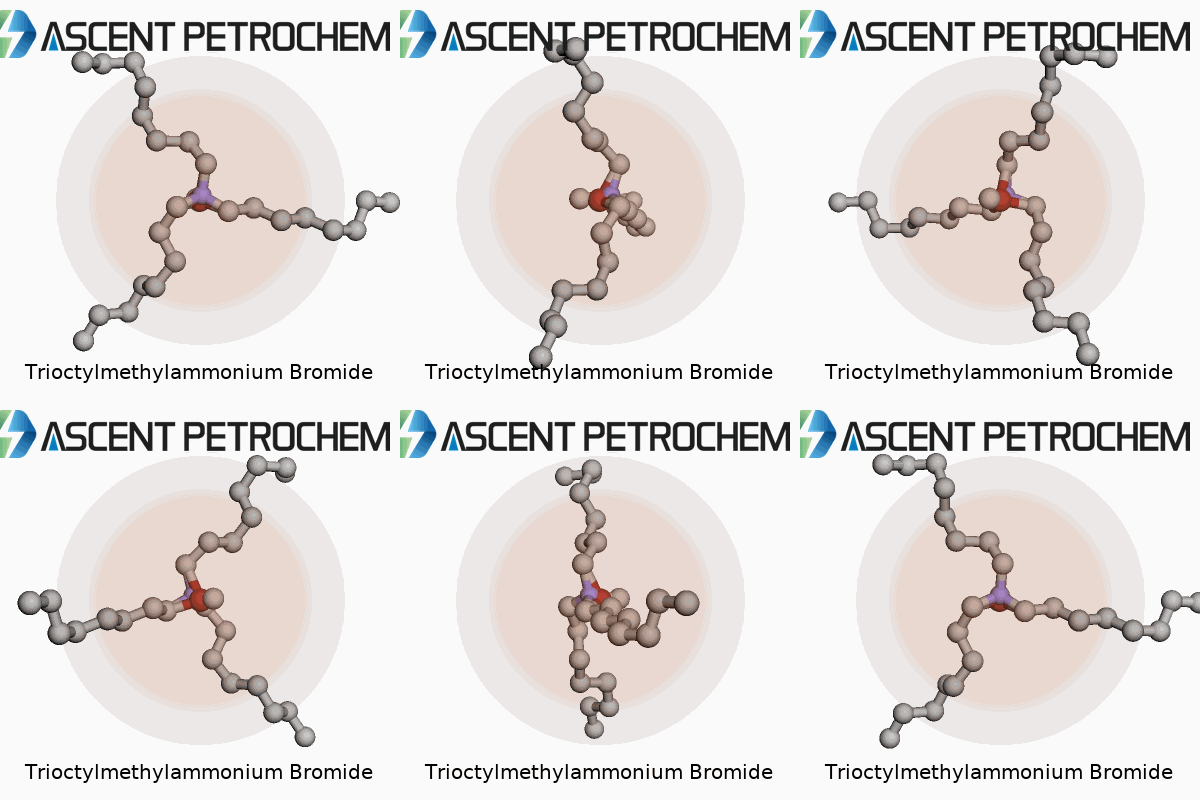
Trioctylmethylammonium bromide brings together four alkyl groups—three octyl chains and a single methyl group—attached to a central nitrogen atom. Picture a nitrogen atom as the hub of a wheel. Three spokes carry octyl groups, each holding eight carbon atoms and rolling into a long, nonpolar chain. The fourth spoke holds a modest methyl group. Tied to this central piece, a bromide ion keeps the charge balanced. Chemically, the molecular formula lands as C25H54BrN.
Floating this structural info into practice, the cation—trioctylmethylammonium—pulls together vast hydrophobic tails, which makes it dissolve easily in organic solvents but not in water. Opposite to sodium chloride, where both parts blend into water, trioctylmethylammonium bromide clings to oil-based environments. The size and shape leave it classified as a “quaternary ammonium salt.”
In the lab, you find this compound acting as a phase transfer catalyst. That means it can drag an ion or molecule from a watery layer over into an oily one, bridging two worlds that usually avoid each other. That trick proved essential for speeding up chemical reactions, especially in organic synthesis. Pulling chemicals from one phase to another cuts down on wasted time, boosts yields, and sometimes makes a tough process possible.
The long octyl groups shield the charged nitrogen, making it less sensitive to the surrounding environment. That design opens doors in making ionic liquids—those special salts that flow like water at room temperature. Industries often reach for these materials when building batteries, cleaning up metals, or designing green chemistry routes that avoid harsh solvents.
Some researchers lean on trioctylmethylammonium bromide for extracting metals, such as rare earth elements or heavy metals from waste streams. Its selectivity and strength allow the target metals to pair with the organic phase, separating them from the water-loaded leftovers. Recovery becomes cleaner, and less junk gets dumped back into the environment. It's not foolproof, but the progress beats several old-fashioned approaches.
Working with this chemical asks for care. The long carbon tails make it low in volatility, so you won’t easily inhale it, but skin contact or swallowing can introduce risks. Quaternary ammonium salts sometimes irritate the skin or affect aquatic life, so waste needs proper treatment. Responsible labs and companies limit exposure, store it correctly, and track how much goes into waste streams. For anyone researching greener chemistry, looking for ways to swap out less friendly solvents, these ammonium salts tick important boxes.
Solving issues tied to persistent chemicals often means focusing on the full life cycle. Finding ways to recover, reuse, or swap out trioctylmethylammonium bromide stays on the radar. Some teams experiment with biodegradable versions or other ionic liquids with similar properties but less environmental drag. Regulatory pressure helps speed up that innovation—companies want results that work as well, but clean up faster at the end.
Chemistry shapes so many corners of daily life, from batteries to building materials. Trioctylmethylammonium bromide demonstrates how a specific molecular structure lets experts connect tough-to-mingle elements—and why fine-tuning those structures still matters in research, sustainability, and industry.
Trioctylmethylammonium bromide doesn’t show up in everyday conversation, but it shows up in plenty of chemistry labs and industrial processes. It falls under the category of quaternary ammonium compounds, often helping with phase transfer during chemical reactions. Handling this stuff changes the game compared to simple solutions or your every day cleaning products.
Skin exposure to chemicals like this can turn into irritation, sometimes causing more intense reactions with repeated contact. I’ve worked with organics that looked harmless; after a few careless days, my hands told a different story. The smartest move involves gloves made of nitrile, not latex, because they stand up to more robust solutes. Lab coats, goggles, and sometimes face shields give another layer—each barrier matters, especially if you can’t predict what splashes. In my experience, chemical-resistant aprons prevent surprises on shirts and skin when an experiment takes a wild turn.
Open bench work with substances like this raises the risk of accidental inhalation. Chemicals seem stable—until a fine dust wafts up, or vapor sneaks out from a heated flask. Local exhaust or a chemical fume hood brings peace of mind. Having worked with compounds that release subtle fumes, I’ve seen headaches come on out of nowhere. Nothing replaces the power of fresh air and a working exhaust system.
People sometimes slide the bottle back into random cabinets—bad idea. Moisture, heat, or contamination knocks stability out fast. In my labs, somebody always checks that the lid goes on tight and the bottle leaves no residue outside. Store this compound away from incompatible chemicals (like strong acids or oxidizers) and out of places that see wide temperature swings. Cabinets marked for corrosives offer solid protection, but it’s the attention to labeling and airtight seals that keeps accidents at bay.
Even a small spill can cause a headache if nobody responds quickly. Absorbent pads or inert materials like sand stop liquid from spreading. Scooping up powder or collecting broken glass should happen with tools, not bare hands. For disposal, following local hazardous waste rules takes priority. Once, I saw a coworker pitch similar waste down the drain, and it led to a shutdown while specialists figured out cleanup. Nobody wants a repeat visit from the environmental safety team.
Reading a safety data sheet takes a few minutes, but those minutes teach you about hazards and first aid. Talking through an emergency plan with the team goes farther than just taping evacuation routes on the wall. It’s the moments where you actually practice what to do if exposure or fire crops up that stick with you—personal stories in the lab have driven home lessons more than any poster.
No shortcut replaces solid preparation. People working with trioctylmethylammonium bromide need to treat it with respect and alertness. Having the right safety equipment, solid practices, and a team that knows the specific risks doesn’t just check boxes; it changes outcomes. Small changes, like routinely double-checking gloves or checking vent hoods before getting started, build a strong culture around chemical safety.
Trioctylmethylammonium bromide grabs attention in chemistry labs for a good reason—its solubility behavior shapes what chemists can actually do with it. Drop it into water, and you see a struggle. This molecule, packed with long hydrocarbon chains, stays mostly out of sight. In practice, water takes up just trace amounts because the hydrophobic tails resist the polar environment. You might catch scientists using phrases like “sparingly soluble” or “barely dissolves.”
In organic solvents, the story shifts. Trioctylmethylammonium bromide mixes well with non-polar and some polar organic liquids. Put it in chloroform, toluene, or dichloromethane, and it dissolves far more easily. Solvents like alcohol or acetone also take it in, but performance varies depending on how polar the alcohol chain runs. A key reason for this—hydrophobic alkyl chains blend right into these organic environments.
Lab work doesn’t happen in a vacuum. Solubility choices jostle with demands from diverse industries. This molecule steps up as a phase-transfer catalyst. Here, its poor water solubility actually proves useful. For instance, you might aim to coax ions from an aqueous layer over to an organic phase. Trioctylmethylammonium bromide acts like a shuttle, helping those ions cross the boundary between the two. This is helpful in organic synthesis, where many valuable reactions hinge on getting the right reagent into the right phase.
If I look back at my own days working with biphasic reactions, the number of hours saved by using the right phase-transfer agent can’t be overstated. Not every ammonium salt fits the bill—Trioctylmethylammonium bromide gets picked for its solubility quirks: enough to move things in organic layers, resistant enough not to vanish into the water where it can’t do the job.
The push for “green chemistry” raises important questions about safety and environmental fate. Poor solubility in water helps limit mobility, which might seem like a win for containment, but persistence in non-polar phases can mean it lingers in soils or sediments. Studies already suggest quaternary ammonium salts can stick around and affect ecosystems, especially aquatic life. Knowing this, users and suppliers have a stake in improving disposal methods. For labs, that means thoughtful solvent recovery, less reliance on halogenated solvents, and exploring greener alternatives when possible.
Solubility drives not only reaction efficiency but also waste generation. Researchers keep hunting for new ingredients that behave just as well, dissolve in less toxic solvents, and offer easier cleanup. Regulatory guidelines keep tightening, and more people seek data about environmental impact. Some innovators are swapping to ionic liquids or biodegradable surfactants, gradually replacing older salts in select applications. Adjusting reaction conditions, such as temperature and solvent blend, can squeeze better performance or safety out of each molecule.
Fact-driven solubility profiles ground practical decisions. Whether for a one-off research project or for ongoing industrial use, chemistry favors those who understand what makes each compound tick. Every solvent choice writes part of that story.
Trioctylmethylammonium Bromide isn’t a name you’ll see at the grocery store, but in chemical plants and science labs, its presence feels routine. Still, behind doors with safety signs, this chemical demands a closer look because slip-ups are costly—sometimes literally, sometimes with people getting hurt. One spill, or even a subtle vapor leak, can make for headaches or worse. Its handling falls under rules set by bodies like OSHA and REACH, which means every shipment and storage container gets extra scrutiny.
This compound stays solid at room temperature, but only if you avoid moisture and extremes in heat. Garnishing my own small lab’s shelves with chemicals taught me: humidity invites clumping, and that’s no minor issue. Dampness can lower purity, spike risks, and slow down projects. Chemical-grade amber bottles, the ones that block sunlight, give the best shot at keeping the stuff stable. Steel drums also show up in bigger shipments, especially when a chemical gets sent across states or overseas.
Freight companies roll out long lists of rules because this chemical falls under “hazardous goods.” That means stickers, manifests, and paperwork pile up. Ships and trucks can carry it, but I’ve seen a few loads held at dock because somebody missed an update in the rules. Most of the time, you’ll see it traveling in sealed drums—tightly capped and shrink-wrapped on pallets. Transport teams ask for dry, covered trucks. Even forklifts at the warehouse must avoid denting the drums; a small crack might open the door to contamination or even a chemical reaction.
Logbooks and inventory programs don’t just score points with the inspector—they help a team lay hands on stock during a recall or an emergency. Chain of custody is more than a buzzword. I worked with a colleague whose lab caught a shipment mixed up with a non-compatible compound and dodged what could’ve been a costly recall. Tracking, barcode scanning, and physical checks mean everyone sleeps better at night.
Solid safety habits start before the chemical leaves the factory and continue until it lands on the lab shelf. Simple advice gets repeated for good reason—store it cool and dry, away from light, double check seals, and always label. But supply chains worldwide see pressures from cost-cutting and speed. Mistakes grow easier in a rush, so some of the latest solutions look beyond just extra paperwork. Third-party audits, regular team training, and smart sensors for humidity aren’t luxuries anymore; they’re showing up as lifesavers when storms or logistics messes introduce risks.
Trioctylmethylammonium Bromide may never become a household name, but making sure the substance is secure on the road and on the shelf becomes not just about avoiding mistakes, but showing what responsibility in science means. Every step in transport and storage, from factory line to beaker, comes down to the choices made by real people, with a lot riding on each one.