Few folks discuss the real journey behind chemicals that change how industries treat extraction, waste management, and separation processes. Trioctyl Methyl Ammonium Chloride—better known to chemists as TOMAC—grew out of early 20th-century efforts to improve liquid–liquid extraction and ion pairing. Research in the 1950s started picking up on quaternary ammonium salts with long alkyl chains, aiming to overcome the limitations of traditional extractants that lost steam outside a narrow pH window. Old patents show engineers messing around with methyltrioctylammonium salts to pull out heavy metals and organic acids. Since then, TOMAC has become a staple in uranium processing, bioseparations, and ionic liquid design, with each decade shaping its refinement and safety management.
TOMAC pops up in labs as a waxy or oily substance, usually pale yellow, with a faint but unmistakable amine smell. Commercial suppliers offer it in small amber bottles or bulk barrels, both for industry and R&D needs. With its broad solubility in organic solvents—toluene, chloroform, even heavier hydrocarbons—it serves as an effective phase-transfer catalyst and extractant, able to shuttle ions or organic molecules across liquid boundaries where most won’t travel on their own. Because suppliers like to guard some secrets, blends might still vary, and serious operators check the bottles for correct labeling: methyltrioctylammonium chloride, Aliquat 336, or sometimes N-methyl-N,N,N-trioctylammonium chloride.
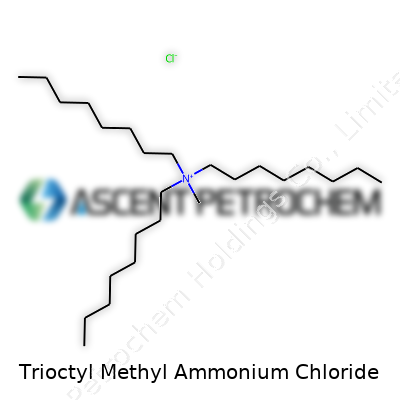
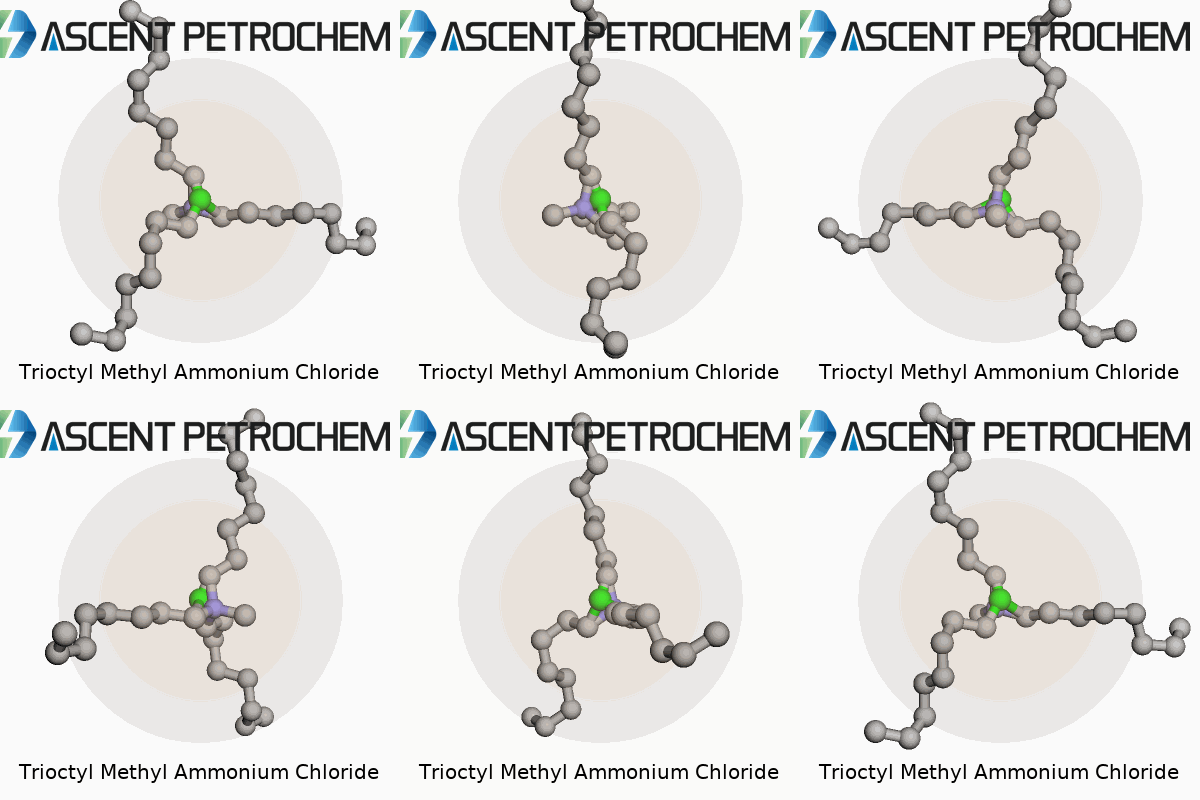
Anyone who's handled TOMAC in a beaker knows it stands out for its viscous, almost sticky nature—sort of like thick syrup at room temperature, but it thins out quickly as things warm up. The density sits around 0.88–0.94 g/cm³. Solubility in water tends to be low, maybe a trace, so it stays mostly in the organic phase during extractions. It doesn’t burn hot like straight hydrocarbons, but it will decompose above 120°C, giving off irritating amine fumes. Stability holds across a range of pH, and it handles typical acidic or basic conditions without breaking down fast—making it valuable for multi-step chemical syntheses. It sits as a cation with three octyl arms and a methyl anchor stuck to a chloride, granting the mix both bulk and grease, yet a surprising ability to lock up with polar solutes like anions and coordinate metals.
Lab-grade TOMAC often posts purity above 90%, though some brands offer 95% or higher for pharmaceutical and specialty applications. The label should always call out the active content, moisture (typically under 2%), and the chloride equivalent. These details matter during reaction scaling, since trace water and unreacted amines will nudge yields or open the door for side reactions. Shipping regulations slot TOMAC under “harmful” or “irritant” classes, and bottles carry the dark exclamation mark or corrosive pictogram. Labels need to spell out the batch number, production date, and full synonym list, since customs and regulatory agencies have a habit of picking up on alternate names.
Synthesizing TOMAC in an academic lab usually involves a straightforward quaternization reaction. In practice, folks mix an excess of trioctylamine with methyl chloride in an organic solvent—dichloromethane or toluene both do the job. The reaction runs under mild heat, and after venting, the residue passes through brine washes and column drying to strip out unreacted amine and excess methyl donor. Large-scale producers tweak solvents and temperatures to maximize yield, sometimes switching to methyl bromide for faster rates. By the end, a viscous, pale oil comes off, ready for further purification and use. It’s simple but brings up safety considerations around pressurized methyl chloride, which calls for solid engineering controls.
TOMAC holds up as a starting point for a heap of downstream chemistry. Reacting with strong bases exchanges its chloride for other anions, making it a doorway to a library of ionic liquids—earth scientists and electrolytic cell builders keep these modifications on speed-dial. Treating the compound with alkyl halides can bulk up its carbon chains even more, deepening solubility and shifting selectivity in extraction protocols. Under acidic or oxidative conditions, it reacts slowly but can degrade, opening up possibilities for tailored breakdown when disposal is a concern. These adjustments support real-world customization for different manufacturing and research workflows.
TOMAC doesn’t always travel by a single name, so those cross-checking paperwork may spot it listed as Aliquat 336, methyltrioctylammonium chloride, or commercial tags like Adogen 464. Patents and older research might mention tricaprylmethylammonium chloride—same deal, just a nod to the eight-carbon (octyl) chains. Having this list handy saves confusion when flipping through MSDS files or tracking regulatory filings because authorities and buyers both depend on clear and consistent naming to connect the dots.
Chemical safety with TOMAC draws a line between lab reality and theory. It irritates skin and eyes on contact, and the fumes can get under your skin after a few hours in a poorly ventilated room. Wearing nitrile gloves and splash-proof goggles at the bench matters. Workplaces that use TOMAC in kilo quantities need fume hoods, spill kits, and a way to deal with contaminated waste—nobody enjoys the aftermath of an accidental splash or inhalation. Emergency plans should run drills for chemical burns because TOMAC’s oiliness sticks around and clings to skin more than water-based hazards. Monitoring for chronic exposure is wise, as cumulative effects in heavy users are still being mapped out.
Easily the most impactful use sits in liquid–liquid extraction: TOMAC chews through metal recovery steps in mining, stripping away copper or rare earths that old-fashioned reagents can’t budge. It enables pharmaceutical refineries to separate actives and impurities when columns top out. Environmental labs use it to isolate organics from complex water samples, hunting pollutants below the parts-per-million line. Industrial wastewater treatment plants lean on TOMAC to mop up nitrates or sulfates, improving compliance with stricter discharge standards. These use cases push the boundaries of what’s possible with traditional solvent systems, proving everyday chemicals can still outfox newer, pricier alternatives.
Over the past decade, R&D has dived into greener alternatives and deeper understanding of how TOMAC interacts with both simple and advanced materials. Teams tweak its structure, swap in different counterions, or explore how it behaves in electrochemical cells or catalysis. The push for environmental sustainability has led researchers to test if TOMAC-based ionic liquids can stand up as low-white, reusable solvents. The new focus on resource recovery—especially lithium and cobalt extraction for batteries—rests on TOMAC’s backbone. Researchers in major labs compare results, sharing tweaks and pitfalls via academic papers, so the collective knowledge base keeps growing.
Every industry chemical deserves scrutiny, and TOMAC is no exception. Older animal studies flagged mild skin sensitization and temporary eye irritation in small mammals, but the big unknown comes from long-term disposal downstream. No strong evidence links TOMAC with high toxicity in mammals at low doses, but regulators watch for bioaccumulation in aquatic systems, especially near waste outflow sites. Recent studies run simulated environmental releases, tracking TOMAC’s fate and its breakdown products. Most data suggest quick environmental partitioning, with limited buildup in fish or plants. Larger safety trials look at sub-chronic exposure in lab rodents, and ongoing work collaborates with soil scientists to profile what happens after years of low-level buildup—essential knowledge for communities near chemical plants.
TOMAC’s future sits at a crossroads: researchers see promise in customized ionic liquids and targeted recovery of rare and precious metals, while regulators urge sharper toxicity profiles and biodegradable variants. The trick lies in marrying TOMAC’s proven power with next-generation green chemistry standards, keeping harmful residues out of water streams without losing extraction muscle. Synthetic chemists keep testing modifications, hoping to find candidates that break down just fast enough to limit environmental risk. Industry talk centers on using recycled TOMAC blends and designing plants that recover and reprocess spent extractants. Academic labs and startups both see a role in battery recycling, medical separations, and bioprocessing—as long as real-world hazards are met head on.
The world of chemicals doesn't always make the evening news, but some substances deserve a closer look. Trioctyl Methyl Ammonium Chloride—people in labs often call it TOMAC—lands on that list. I came across TOMAC during a stint consulting for a water treatment project, and it’s surprising how often it pops up behind the scenes. Factories and processing plants rely on this compound, yet most people never hear its name.
Take solvent extraction. Many metals, like zinc or copper, go through complex separation steps before they ever become sheet metal or wire. TOMAC acts as a phase transfer catalyst. In simple terms, it helps substances that usually don’t mix swap places between water and organic solvents. Without TOMAC, a lot of these separation steps grind to a halt or turn into expensive headaches.
TOMAC steps into the pharmaceutical world as well. Some drug manufacturing processes use it for similar catalyst roles—helping selective reactions occur, maintaining purity, and speeding things along. Even minor changes in the efficiency of these steps affect how long it takes to fill prescriptions or meet urgent medical needs.
A big share of TOMAC’s influence appears in industrial water treatment. Plants add it to adjust ion balances, battling problems like heavy metals that threaten both equipment and the environment. I remember running a pilot project in a textile factory. We couldn’t hit discharge limits for heavy metals until we switched to TOMAC. Effluent went from failing to passing tests in two weeks. Health inspectors saw improvement, too. These changes don’t just keep fines away—they protect communities and wildlife downstream.
Factories choose TOMAC partly for its stability. It doesn’t break down under tough heat or strong chemicals, so it fits rigorous industrial needs. Chemical firms also prefer it because the product keeps its properties consistent across batches. That’s a huge deal if someone runs a large-scale operation where ruined product means lost jobs and wasted resources.
Safety questions always come up with industrial chemicals. TOMAC can be hazardous if handled poorly, which I’ve seen firsthand watching workers skip gloves or ignore ventilation. Over time, these risks add up. Companies need to invest in better training and equipment, not just because the law demands it, but because lives depend on it.
Environmental impact matters, too. Disposal of waste containing TOMAC pushes companies to think beyond compliance. Modern plants start treating spent solutions on site, breaking TOMAC down or capturing it for reuse. This isn’t just a PR win—it lowers disposal costs and keeps regulators satisfied.
I have seen some big improvements as scientists and engineers work to tweak the molecules. Researchers keep exploring safer, biodegradable options that do TOMAC’s job but leave less impact. Industry partnerships with universities have produced papers and even commercial prototypes of alternative catalysts.
Transparency stands out as another solution. When companies publish the steps they take to handle and limit TOMAC use, trust grows. Employees and the public get a clearer view of risk and reward. Over the years, I've watched communication break down dangerous assumptions and lead to safer workplaces.
TOMAC will keep finding use as long as industries need tough, reliable catalyst agents. Improving worker protection, rethinking waste, and investing in alternatives all help this process remain both profitable and safe.
Trioctyl methyl ammonium chloride, sometimes popping up in chemical catalogues under the name Aliquat 336, shows up across a surprising range of industries. People use it in extraction processes, as a phase-transfer catalyst, and sometimes in research labs for moving heavy metal ions from one liquid phase to another. Each time I grab a chemical catalog and see it listed, I remember past workplaces where curiosity about its safety came up nearly as often as requests for its material safety data sheet.
My experience handling quaternary ammonium salts always prompts a bit of caution. Trioctyl methyl ammonium chloride doesn’t smell particularly strong, and in pure form, it flows like an oily liquid—easy to handle, but with hidden dangers. Dermal absorption matters here, since skin contact can bring on irritation, burning, or more serious effects if exposure is prolonged. Safety data sheets highlight this. Spills on skin can cause redness or swelling, and if it splashes into eyes, immediate washing is critical to avoid lasting damage. Breathing in vapors seems rare because of its low volatility, but splashing and aerosolizing during handling still brings risk.
People sometimes overlook the risk of chronic effects. Nitrile gloves, goggles, long sleeves, all feel necessary with this compound, since studies suggest that quaternary ammonium compounds may disrupt cellular membranes. This raises concerns for both short-term health and long-term toxicity, especially for repeated workplace exposure. Accumulating research sheds light on these risks. According to toxicological reviews, certain quats have shown a knack for causing reproductive and developmental issues in laboratory animals. Though direct studies on trioctyl methyl ammonium chloride stay limited, its family’s broader toxic profile pushes industries to treat it as hazardous until proven otherwise.
Spills don’t respect laboratory boundaries. Any significant release threatens aquatic environments because quats often cause toxicity in fish and invertebrates. From my old lab days, I recall how careful we had to be around sinks—even a small amount of waste product could cause trouble downstream. Research published in environmental journals reveals that these compounds linger and resist biodegradation under certain conditions, making them a tough contaminant to clear out. Careless disposal, especially into local water sources, earns quick regulatory attention for good reason.
Every hazardous compound asks for a management plan, not just gloves and goggles. Good ventilation, spill containment strategies, and staff training all help make sure trioctyl methyl ammonium chloride doesn’t surprise anyone. Speaking from experience, regular drills and purchasing proper absorbents makes responding to accidents less stressful. Fume hoods, clear labelling, and up-to-date safety protocols offer more than compliance—they genuinely protect people.
Outside the lab, waste collection matters. Handling agencies need clear labeling and secure containers, since leaking packages multiply risks. Environmental protection agencies in most countries regulate disposal, treating any release as a reportable incident that triggers swift remediation. Legal penalties aside, the health of downstream communities remains at stake.
While trioctyl methyl ammonium chloride fills a technical role, chemists and manufacturers keep exploring less toxic alternatives. Substitution plays a key part in minimizing harm, sometimes through greener phase-transfer catalysts or by rethinking the underlying process. Chemicals with lower toxicity and better biodegradability shorten the cleanup process and shield workers and nature from lingering harm. The move toward green chemistry isn't just a corporate slogan—it's personal for anyone who has handled hazardous materials for years.
Trioctyl methyl ammonium chloride, known for its tongue-twisting name, carries a formula that looks simple at first: C25H54ClN. Breaking this down, the “tri” flags up three octyl chains—each one a string of eight carbon atoms. The “methyl” marks that extra one-carbon chain. With all those long hydrophobic tails and the charged chlorine, this molecule mixes the oily with the ionic. That’s not just chemistry trivia; it’s exactly what pushes this compound into all sorts of industrial uses. Think phase transfer catalysts, solvent extraction, and electrochemistry, where this kind of ‘dual personality’ can be a game changer.
Getting the formula right makes a big difference in real-world labs. One wrong digit means the wrong material, messed-up reactions, and wasted time or money—not to mention safety issues. Trioctyl methyl ammonium chloride doesn’t just float around by chance. It shows up in liquid-liquid extraction, helping scientists pull precious or hazardous metals from waste streams. It kicks in for things like rare earth separation and even helps in drug development. In my own college experience, we learned to respect these quaternary ammonium salts because their structure controlled everything from solubility to what they would react with. I still remember the strict reminders: double-check your formula before reaching for the bottle.
Many students memorize formulas. Few pause to connect the structure to its quirks. That core nitrogen, with four groups bolted on, turns trioctyl methyl ammonium chloride into a “quaternary ammonium salt.” Those octyl arms give the molecule a greasy, oil-loving side, while the charged nitrogen and chloride drag it into the water-loving world at the same time. This split makes it valuable in 'phase transfer'—helping move ions between oil and water layers, so reactions that normally wouldn’t happen suddenly go forward. If you’ve ever made mayonnaise or watched oil and vinegar try to mix, this kind of chemistry starts to make a lot of sense, even outside the lab.
The formula might look harmless, but the industrial reach of quaternary ammonium salts brings up urgent questions for health and the environment. Handling these chemicals without proper training can lead to skin and respiratory irritation. Large-scale releases trigger toxic effects in aquatic environments, upsetting fragile ecosystems. Europe has already flagged some quats for monitoring, and researchers keep probing how these molecules break down—or don’t—in water. From years working in environmental monitoring, I’ve watched how persistent chemicals quietly build up where we least expect. Wastewater treatment faces tough questions about removing these molecules entirely instead of just shifting them from one place to another.
Industry and academic labs can’t just ignore the risks for the sake of easy chemistry. I’ve seen more labs turning to safer alternatives or improving containment and waste management. Substituting less toxic quaternary salts, recycling where possible, and investing in better treatment technology all reduce the burden. Open communication about proper storage, labeling, and disposal isn’t just best practice—it’s basic respect for both coworkers and the surrounding community. Teaching chemistry means not just explaining formulas but helping each new generation weigh safety, environmental, and ethical factors for everything they use, down to the last molecule.
Anyone who has worked in a lab, warehouse, or manufacturing site knows chemicals have personalities of their own. Some play nice; others, like Trioctyl Methyl Ammonium Chloride, demand a bit more respect. On one shift years ago, I remember the sense of responsibility that hit me after opening a drum labeled with this name: this stuff reacts with moisture and doesn’t forgive forgetfulness.
Trioctyl Methyl Ammonium Chloride (TOMAC) comes with real risks tied to improper handling and storage. Leakages, environmental contamination, or even health hazards for colleagues can appear faster than you think. That’s enough reason to review good storage habits any time.
Water never mixes well with TOMAC. The compound can decompose if it soaks up enough humidity, triggering the release of irritating fumes and possible degradation. From my experience, once a container started sweating in a poorly ventilated storeroom during a summer heatwave, the job shifted from simple handling to full-on emergency response. Scrambling for absorbents and respirators added plenty of stress.
Store TOMAC drums in a cool, dry place with consistent temperatures. Insulated shelves away from sun-exposed walls cut down the risk of heat spikes. Dehumidifiers and hygrometers keep watch on circulating air and stop moisture creep, especially in climates where humidity quickly climbs during rainy seasons.
Not all containers offer the same guarantee. Polyethylene and glass bottles protect TOMAC from leaks and reactions, but I learned that a cracked cap is just an invitation for fumes to escape. Plastic liners inside metal drums give a second line of defense. If budget or logistics push toward recycling containers, think twice. Residual waste or old sealants sometimes react with TOMAC, leading to unexpected corrosion.
In crowded storage areas, containers bump and labels fade. TOMAC must stay well away from acids, oxidizers, or any incompatible chemicals. Mixing risks chemical burns or toxic gas formation. On more than one occasion, I’ve seen accidental splashes from incompatible stocks cause minor incidents. Separate shelving, color-coded tags, and regular training cut down this risk and make checks easier for everyone.
OSHA and EPA recommend easy access to Safety Data Sheets (SDS) for every chemical, TOMAC included. SDS sheets break down hazards, first aid, and storage guidance in plain terms. For new hires, I always emphasize reading these documents before handling or moving chemicals. For myself, I find periodic spot-checks of labeling and container condition catch lapses before they grow into real threats.
Proper ventilated storage, regular temperature tracking, and documentation combine to create a safer workplace. Spills or leaks rarely escalate when everyone double-checks storage, especially during inventory reviews or after room renovations.
Nothing replaces knowledge and teamwork. By running through emergency spill drills and refreshers on chemical compatibility, storage mistakes drop. Long shifts go faster when coworkers feel confident about every step from shelf to bench.
TOMAC’s safe storage does not rely on luck or expensive gear. A few simple protocols—and a sharp eye—set teams up for smooth, incident-free operations. Manufacturing and research facilities run best when safety isn’t just a rule, but a shared habit.
Years ago, I worked with a team hunting for safer and greener ways to make chemicals. Researching quaternary ammonium salts, the name Trioctyl Methyl Ammonium Chloride (TOMAC) kept popping up in patent files and journals. These chemicals aren't the ones we see on labels at the hardware store. Still, their reach goes surprisingly far, thanks to a knack for helping oil and water to talk to each other—a rare gift, especially in big manufacturing processes.
Oil and gas operations lean on chemicals that coax hydrocarbons out of stubborn pockets underground. In my time consulting for a specialty chemicals distributor, customers working on enhanced oil recovery always asked for what they called "phase transfer catalysts." TOMAC became a favorite because its big, greasy tail lets it shuffle ions between the water and oil layers. Without something like TOMAC, certain reactions stall out, wasting energy and leaving valuable product stuck below ground. I heard colleagues in Texas swear by it for solvent extraction of heavy metals, stripping out copper and uranium from slurries no filter can handle alone.
I once needed to scale up a chemical reaction for a generic drug compound. Phase-transfer catalysts, like TOMAC, turned what was a laboratory headache into a smooth continuous process. Pharmaceutical chemists often add this compound when they want two ingredients to react, but those reactants won’t mix in the same liquid. TOMAC’s structure lets it transport reactants across oily and watery layers, making reactions happen with fewer byproducts. Speeding up these transformations cuts down on waste. The finished medicines often come out cleaner, which matters when purity stands between you and regulatory approval.
In metal refining, especially copper, nickel, and rare earths, separating valuable minerals from the junk takes clever chemistry. One metallurgist joked to me that every step is a battle between the rocks and the chemist’s toolbox. TOMAC has become a tool for extracting metals from leach solutions, where it grabs hold of metal ions and drags them from one liquid to another. This trick, called solvent extraction, shrinks the equipment footprint and cuts down energy use—a must for modern facilities facing pressure on both costs and emissions.
My friend who runs a municipal water treatment plant pointed out the need to remove stubborn organic pollutants. While they don’t splash trioctyl methyl ammonium chloride around by the barrel, specialty units handling pesticide-filled runoffs or landfill leachates sometimes turn to TOMAC-based processes. The chemical’s way of ferrying ions between water and organic solvents helps lift out contaminants that settle nowhere else.
The strength of TOMAC shines brightest where chemists face stubborn barriers. Businesses in oil, pharma, mining, and water treatment rely on its ability to push boundaries between immiscible phases. Anyone worried about sustainability will see the need for tighter controls—greener alternatives or recycling strategies should ride alongside TOMAC use, limiting environmental impact and operator risk. Whole communities benefit when industry experts start looking for smarter blends and recovery practices instead of clinging to what works today just because nobody has pushed for something better.