Triethylmethylammonium chloride belongs to a class of quaternary ammonium salts that entered chemical research in the early 1900s. Pioneering chemists were searching for alternatives to traditional organic bases, and this compound—often abbreviated as TEMAC—gained traction thanks to its unique combination of solubility and relatively high chemical stability. Labs focused on this family of compounds for their ability to enhance phase transfer catalysis, supporting synthetic chemistry as the 20th century moved forward. It didn't take long for researchers to translate lab insights into industrial applications, especially as the world’s demand for selective catalysts continued to grow in pharmaceuticals and specialty chemicals.
Triethylmethylammonium chloride shows up as a fine, white or off-white crystalline solid—sometimes as a powder, sometimes as granules—depending on the production batch. Producers ship it in tightly sealed containers to keep out moisture, for good reason: the substance picks up water quickly. This quaternary ammonium salt provides a strong ionic environment, making it valuable in synthesis and catalysis where other more traditional chloride sources might fail. In labs, the compound serves both as a reagent and as a supporting electrolyte for electrochemical experiments.
Physically, the compound sports a melting point in the range of 175–180°C, and it dissolves without much fuss in water and many polar organic solvents. Chemically, it's a stable solid at room temperature, retaining structural integrity during standard storage when kept dry. The ionic nature guarantees high conductivity in solution, supporting its role in various analytical and preparative contexts. The chloride ion remains available for substitution reactions, while the bulky triethylmethylammonium cation resists unwanted side reactions, lending the compound a reliable performance profile across the board.
Any batch that reaches the market carries a label that highlights the molecular formula (C7H18ClN), molecular weight (151.68 g/mol), and purity—often at or above 98% for reagent grade. Safety hazard statements take up prominent space, with detailed instructions for storage and handling. Lot numbers and batch testing data support traceability, reflecting the industry’s commitment to transparency and accountability. Labels and documentation stick to the requirements of regulatory bodies such as OSHA, REACH, and GHS, which gives users peace of mind and supports best practices.
The most common preparation approach involves alkylation of a tertiary amine, such as triethylamine, with a suitable methylating agent—usually methyl chloride in a controlled environment. Producers rely on condensation techniques at elevated temperatures and under pressure to avoid runaway reactions. Post-synthesis, the solid product precipitates and gets purified via recrystallization. The yield and purity depend on the quality of starting materials as well as the precision of operating conditions. Many labs prefer in-situ synthesis to avoid dealing with a moist, hygroscopic product during storage or transfer.
Chemists tap into TEMAC’s potential as a phase transfer catalyst. It facilitates exchange of ions between otherwise immiscible phases, streamlining reactions that previously required more time or harsher conditions. The chloride ion participates in common nucleophilic substitution reactions, transferring easily to reactive centers. The triethylmethylammonium cation, being large and hydrophobic, keeps the reaction localized at phase boundaries. That makes TEMAC a popular choice for organic syntheses where cleaner yields matter. In addition, the backbone sometimes undergoes N-alkylation or N-dealkylation, expanding its role depending on what the synthesis needs.
On product catalogs and chemical registries, triethylmethylammonium chloride appears under several names. Notably, researchers recognize it as N,N,N-Triethyl-N-methylammonium chloride, or simply TEMAC. International standards list it under registry numbers such as CAS 1611-86-1, and some vendors shorten the name for labeling purposes, dubbing it MTEACl. This can create confusion for newcomers, but seasoned lab workers watch out for these names and check the fine print to ensure the product matches their requirements.
Safety data points to moderate irritation risks if the compound comes in contact with skin or eyes, and ingestion is not advised. Workers use gloves, goggles, and respirators where dust or powder may become airborne. Companies follow the latest GHS classification for labeling hazard statements, taking into account local regulatory frameworks in Europe, North America, and Asia. Labs and production setups invest in spill kits that neutralize or absorb spills of this salt, preventing issues with corrosion or environmental release. Training sessions cover first aid steps, waste handling, and rapid decontamination, which supports a healthy work environment.
Lab benches and pilot plants make regular use of TEMAC in organic and organometallic syntheses. It appears in electrochemical research, supporting the conductivity of experimental electrolytes while avoiding interference with test reactions. Industries that make pharmaceuticals take advantage of its phase transfer abilities, relying on its stable ionic character for cleaner processes and improved selectivity. The chemical industry sees value in its reliability, with specialty synthesis, material science, and even some biochemical studies drawing on its strengths. The diversity of use cases tells the story of a compound that offers both precision and flexibility in environments with strict quality standards.
Ongoing research dives deep into tuning the reactivity and selectivity of phase transfer catalysts. Chemists push boundaries by pairing TEMAC with novel substrates, optimizing solvent systems, and adjusting reaction conditions for better efficiency. Universities use it as a teaching tool in advanced chemistry curriculums, given its clear-cut behavior and well-documented reactions. Industrial R&D teams look for hybrid catalysts that leverage the unique properties of quaternary ammonium salts like TEMAC, aiming for improved yields and more sustainable synthesis strategies. As regulatory pressures increase around process safety and waste minimization, TEMAC finds itself right in the conversation for next-generation chemical manufacturing.
Toxicologists have long studied the potential impacts of quaternary ammonium salts. So far, triethylmethylammonium chloride falls into the moderate-to-low toxicity range based on acute exposure studies, but researchers stay vigilant about chronic or high-dose effects. Investigations on aquatic organisms point to possible ecological risks if large quantities enter water supplies. The compound doesn’t readily bioaccumulate, but strict disposal protocols keep it away from sensitive ecosystems. Regulatory agencies demand rigorous safety data before new uses or formulations hit the market. Labs continue to test its breakdown products and study inhalation, dermal, and oral exposure to make sure new standards don’t catch anyone off-guard.
The push for greener and more efficient chemical processes only adds value to reliable agents like TEMAC. Researchers chase lower-waste syntheses, and this phase transfer catalyst combines ease of use with proven effectiveness, keeping it central to experimental design. Technology upgrades continue to open new uses for similar quaternary ammonium salts, with battery technology, advanced catalysis, and ionic liquid formation drawing from a century of data gathered from TEMAC. I see the next chapters of this compound woven into a broader story—one where safety, sustainability, and performance can pull in the same direction. This is a chemical with a history, a present, and plenty left to offer.
Triethylmethylammonium chloride may sound like the kind of thing better suited to a high school chemistry quiz, but it plays a bigger role in the way chemistry shapes our daily life than most people suspect. With a molecular structure built for heavy lifting, this salt turns up in niches where few other materials can compete.
My time spent in a university lab showed that much of the real innovation happens with the help of compounds like this one. Triethylmethylammonium chloride acts as a quaternary ammonium salt, giving chemists a versatile tool for ionic reactions. Its value jumps in organic synthesis work—where it helps swap out ions in both small-batch tests and larger pilot studies.
One classic example: carrying out phase-transfer catalysis. This compound helps move reactants between water and organic solvents. That’s important in getting stubborn molecules to actually react instead of floating past each other. Over the years, I saw this benefit when we pushed beyond bench-scale research toward process development in pharmaceuticals. It kept the pace high and the yield acceptable during experiments that counted.
Quaternary ammonium salts like triethylmethylammonium chloride show up in industries ranging from detergents to electroplating. They often help speed up electrochemical reactions, acting almost like traffic cops for ions. In electroplating, for instance, adding this substance means you can control the smoothness and quality of the final metal deposit a lot more easily.
People who work with analytical instrumentation appreciate that it provides a steady, well-characterized ion for calibrating and tuning measurement equipment. Even outside the big industries, you might bump into triethylmethylammonium chloride as a reagent in research kits sold to educational labs—proof that high-end chemistry isn't just boxed off for experts.
Using any chemical in a hands-on lab or full-scale facility calls for some common sense. Triethylmethylammonium chloride is no exception. It stands out for being relatively stable, but that doesn’t give a free pass for careless handling. Direct contact can irritate the skin and eyes, and nobody wants to breathe in powdered chemicals without solid ventilation.
From what I’ve experienced, most responsible facilities have training for proper disposal and storage, keeping risks in check. Waste streams often face extra scrutiny to limit environmental release of quaternary ammonium compounds. That's especially true since, once diluted in large bodies of water, they can contribute to aquatic toxicity if forgotten in the disposal plan.
Today, a lot of companies look at their raw material list and search for ways to cut their footprint. With triethylmethylammonium chloride, that means investing in better recovery and recycling techniques. Closed-loop systems, where the chemical is reused through several runs before actual disposal, see more interest now than even ten years ago.
Green chemistry pushes—for both economic and environmental reasons—continue to shape how these salts are used. Groups like the American Chemical Society have set out guidelines that encourage safer alternatives or process tweaks that use less of the compound without losing performance. Small steps, but the industry gets less reliant on waste-heavy solutions. That’s a point to consider whether you work in a national lab, a teaching school, or a manufacturing plant.
Triethylmethylammonium chloride might keep a low profile, but it turns up right where the action happens in modern chemistry. With its wide range and adaptability, it connects breakthroughs in reaction design with the need to run safe and responsible operations. Whether I look back at my early research days or glance at how manufacturers plan out their next five years, this chemical keeps cropping up as a quiet workhorse—one that deserves a little more attention, both for what it can do and how it might evolve along with new technology and sustainable practices.
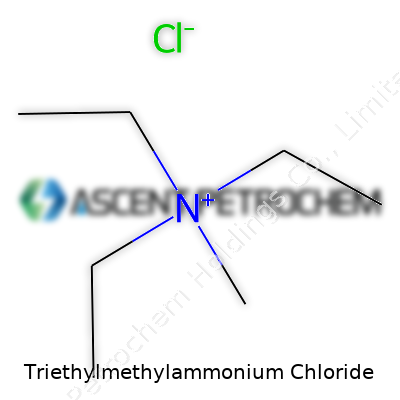
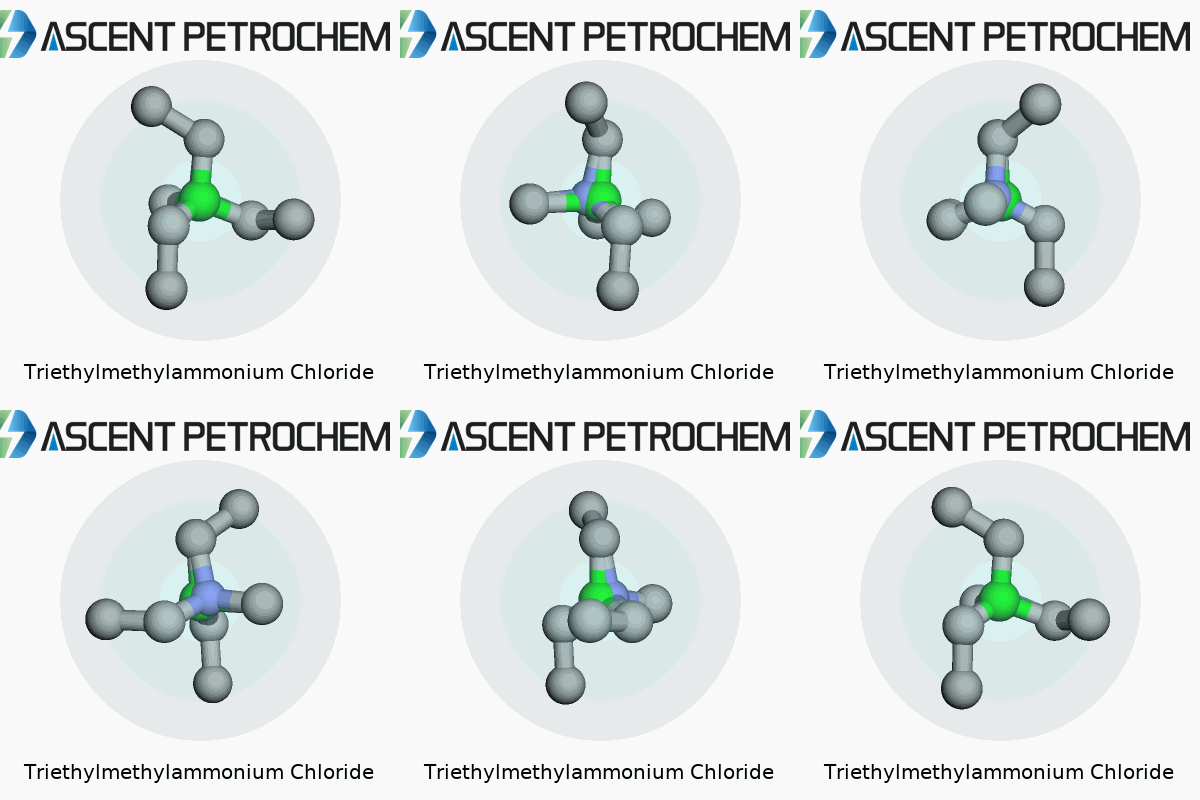
Triethylmethylammonium chloride, with the chemical formula C7H18ClN, doesn’t pop up in small talk or on the shelves of your local pharmacy. Still, this quirky-sounding salt packs real relevance in labs, manufacturing, and research. You start with a nitrogen core connected to three ethyl groups and a methyl group. Add a chloride anion to balance the charge. That brings reliability and a dash of chemistry lore, especially for those who end up handling these sorts of reagents.
On the surface, C7H18ClN looks like a jumble, but there’s structure hiding behind those letters. The “triethylmethylammonium” part signals a positively charged ammonium ion, where nitrogen hangs onto three ethyl chains and one methyl chain. The chloride ion comes along for the ride, evening things out. Students, chemists, and anyone working with organics or ionic compounds tend to care about the formula because it tells them how the molecule behaves. Structure shapes everything—from how a molecule dissolves to which solvents it tolerates, and even how it might interact with DNA or proteins in experimental chemistry.
Once you dig into the use cases, the formula’s importance pops. Triethylmethylammonium chloride steps up as a phase transfer catalyst, helping chemicals talk to each other even when they come from two barely-mixing layers. It often pushes sluggish reactions along in organic synthesis, especially for those who need to create unusual bonds or shuffle atoms between liquids that don’t mix easily. Having worked with phase transfer catalysts, you notice quickly how much easier they make life. Reactions that used to drag on for hours finish quicker, and yields bump up without any magic involved. It all comes back to that clear formula—get the structure right, and the benefits follow suit.
Most news skips over chemistry unless it concerns medicine or pollution. Triethylmethylammonium chloride doesn’t save lives in a flashy way, but it supports innovations behind the scenes. Long before new plastics, pharmaceuticals, or agricultural chemicals show up in the market, odd compounds like this one help researchers connect dots. For example, ionic liquids—salts that stay liquid at room temperature—often use organic cations similar to this for greener processes. Cutting out volatile organic solvents cuts down on emissions and takes some strain off workers who handle nasty chemicals every day. Lab life gets safer, cleaner, and more efficient.
No discussion about chemicals goes far without facing up to the realities of health and safety. Quaternary ammonium compounds, including triethylmethylammonium chloride, can irritate skin, eyes, and the respiratory system. Researchers need solid protocols. Labeling, ventilation, gloves, and training—these aren’t extras. Early in my lab work, taking shortcuts almost led to a nasty exposure. A bit of care, supported by up-to-date material safety data sheets, lets the science move forward without compromising health.
Chemistry shapes much of the modern world, mostly outside the spotlight. Triethylmethylammonium chloride’s formula, C7H18ClN, captures just one chapter in a much bigger story. Keeping science transparent, sharing what these building blocks mean, and supporting stronger lab standards—all of that helps science earn trust. Better practices today mean smarter, safer innovation tomorrow.
Triethylmethylammonium chloride is a quaternary ammonium salt. Labs and industries use it as a phase-transfer catalyst or in organic synthesis. Its chemical relatives sometimes pop up in disinfectants or other cleaning products. So, many might wonder about its safety, especially if they see a mention of ammonium compounds and recall stories of chemical accidents or chronic exposures in industrial jobs.
Working with chemicals in labs and plants, I’ve seen firsthand how easy it is to let your guard down around substances that look safe. Triethylmethylammonium chloride forms a white, odorless, crystalline powder, but visual cues never tell the real story with chemicals. The bigger risk often comes during handling or when someone skips gloves or ignores other personal protective equipment. With this compound, skin and eye irritation can happen after contact. Mixing it with water or other solvents doesn’t produce a violent reaction, but the dust isn’t something you’d want to inhale either. Dust exposure can irritate the nose and throat, which can become a pattern if you work with it often or in large quantities.
Research points out that this chemical isn’t as acutely toxic as some other industrial materials, but gaps still remain in our understanding. High doses or repeated exposure can harm lab animals, but those studies use much heavier concentrations than you’d find in most workplaces. There’s no strong evidence linking triethylmethylammonium chloride to cancer or severe chronic effects in people, but that’s partly because few studies have been done on workers who use it regularly. Related chemicals do show developmental and reproductive effects in animals, though, so caution makes sense.
For a worker, casual handling can add up over years. Even modest irritants or inhaled dust may raise the risk of long-term respiratory trouble. People with asthma or allergies sometimes find they react to quaternary ammonium compounds more strongly, so a worker getting rashes or breathing trouble shouldn’t feel silly about asking questions or pushing for better ventilation.
Sensible safety habits always beat emergency fixes. In one lab I worked, we doubled up on gloves when transferring thiols with quaternary salts like this one. Keeping containers tightly sealed and labeled never felt like overkill. Fume hoods made handling and weighing much less stressful. Simple changes like installing better air-handling systems cut down dust, which kept the whole team healthier over the long term. Employers hold responsibility for training staff to spot early signs of exposure—itchy eyes, dry or red skin, cough—since prompt action keeps small problems from snowballing.
Spills rarely draw news, but even a small pile on the bench can become an inhalation hazard if swept with a dry brush. Damp cloths or vacuum systems fitted with filters work better in containing dust. Anyone handling bulk material should keep emergency eyewash and showers close by, even for substances “not known to be highly toxic.”
Unknowns always come with chemical work, but pretending something is safe just because it isn’t labeled “extremely hazardous” misses the point. Clear communication and easy access to updated safety data sheets build trust and reduce errors. Triethylmethylammonium chloride probably won’t make headlines, but treating its hazards with respect keeps everyone on the right side of health and the law. If research reveals new risks in the future, open dialogue and a willingness to adjust workplace habits will matter more than any hasty assurances.
During late nights running titrations, I witnessed firsthand how careless storage practices can turn a routine day in the lab into a scramble for the eyewash station. Triethylmethylammonium chloride doesn’t get headlines like sulfuric acid or sodium cyanide, but overlooking its handling can bring headaches—sometimes quite literally. This compound, a colorless or white crystalline solid, requires careful attention, not just for safety, but for maintaining its purity and function across research and industry.
Dampness never mixes well with most salts, and triethylmethylammonium chloride stands no exception. Any moisture can cause clumping, degrade chemical quality, or trigger unwanted reactions if contaminants creep in. A dedicated storage cabinet, kept dry and cool, dodges these issues. I used to rely on desiccators with fresh silica gel—simple, affordable, and highly effective. Labs aiming to stretch budgets and cut cleanup time would do well to borrow this practice. Even storerooms with periodic temperature swings can threaten product quality, so keep this chemical out of areas exposed to direct sun or radiators.
Many chemicals arrive in glass or plastic containers with tight-fitting lids. I always inspect for cracks and swap out any suspect packaging. A single unnoticed hairline fracture might seem harmless until a spill scatters powder across shelves, risking exposure and contamination. Clear labeling is more than bureaucracy—mistakes can devastate projects or put colleagues in danger. Permanent markers on chemical-resistant tape or labels hold up best. Remind coworkers to double-check labels before every use, and you avoid disasters from confusion over similar-looking powders.
Though triethylmethylammonium chloride doesn’t bring major fire hazards on its own, that doesn’t give license to ignore general chemical safety. This salt can irritate skin, eyes, or lungs. Over the years, I watched new students skip gloves “just for a quick measurement,” only to spend the next few hours nursing irritated skin. Standard lab gear—gloves, goggles, and a dust mask for large batches—keeps exposure in check. Accidental releases should get immediate attention with spill kits made for dry chemicals. Never use a vacuum with a household filter; high-efficiency particulate air (HEPA) models keep particles from cycling back into the air.
Every tub or jar of triethylmethylammonium chloride deserves a clear entry in a storage log. Tracking purchase date and condition at each opening lets labs spot problems before they spread. Our team used a simple spreadsheet and quick check-ins every week. Small steps like this reveal leaks or expired stock before problems show up in experiments. Keeping usage lean and frequent ordering cycles avoids piles of old stuff that just take up space and invite confusion.
No chemical lives in isolation. All staff and students who work nearby need clear training. A brief in-person walkthrough covering storage, labeling, and emergency steps builds good habits. Posters at eye level near storage areas sum up the essentials and stay fresh in everyone’s mind. This hands-on approach brought down incidents and helped everyone sleep better at night, knowing no surprises lurked inside the chemistry storeroom.
Triethylmethylammonium chloride comes across as a common quaternary ammonium salt if you’ve spent any time in a chemical lab. I’ve handled it during organic synthesis runs, and its physical appearance doesn’t hint at the risks it brings. Forget the mild look—this compound deserves attention. It can irritate eyes, skin, and the respiratory tract, which points to serious problems in the lab if folks don’t prepare. Reading up on the safety data sheet is something everyone should do before reaching for this chemical.
I can’t count the number of times people ask if gloves and goggles are overkill in the lab. Anyone who scoffs at basic protection hasn’t spent time cleaning up chemical spills or rushing a colleague to the eyewash. For triethylmethylammonium chloride, nitrile gloves, safety goggles, and a lab coat are non-negotiable. This salt irritates on contact and causes burns if it sits on the skin for long. Splashing into eyes would mean pain, possible damage, and a very real trip to medical care. Closed-toed shoes keep spills away from feet, and washing hands before leaving a work area keeps the compound from leaving ghostly trails.
Preparation in the lab always beats improvising after a spill or exposure. I’ve seen plenty of labs get creative with storage, but for triethylmethylammonium chloride, a tightly closed container in a cool, dry, ventilated space keeps moisture and contamination at bay. This compound draws water from the air; if a bottle sits open on a bench, it clumps and spreads mess. Chemical fume hoods cut down inhalation risk and control dust. Before starting any work, set out clearly labeled bottles, weigh the chemical with a spatula (never touch directly), and clean up promptly.
Every lab worker dreads that moment—something tips over, or powder puffs into the air. For small spills of this chemical, scoop up with care, place waste in a sealed bag or bottle, and wipe down the area with water. Larger spills need a coordinated response using spill kits. I’ve personally called for outside help to clean up a big unknown spill; it’s embarrassing but always better than endangering health. Waste pooling into the regular garbage or a sink leads to regulatory headaches and environmental harm, not to mention possible fines. Labeled hazardous waste containers and consulting with your organization’s disposal manager saves hassle.
Problems only show up when training gets ignored or documentation goes missing. In my experience, the best labs walk new folks through real-life scenarios, not just paperwork. Document every use, label secondary containers, and tie your notes back to batch records. I’ve seen a single missing log cost a research lab weeks of repeat work. Health and safety training drills, regular reminders, and peer communication build a culture where safety isn’t a last-minute thought but a daily habit.
If someone starts coughing, rubbing their skin, or tearing up in the lab after working with this salt, don’t wait—move outside, hit the eyewash or shower, and flag down a colleague. Reporting exposures and seeking care keeps minor irritations from turning into medical emergencies. Quick action, common sense, and following established safety principles have saved me and others from a lot of trouble.
Working safely with triethylmethylammonium chloride doesn’t take heroics—just solid habits, clear labeling, and respect for the risks. Scrutinize systems for weak spots, keep safety gear in easy reach, and don’t shortcut training. Careful stewardship and looking out for each other are the strongest protections any lab community has.