Tetrapropylammonium bromide emerged early in the wave of synthetic quaternary ammonium compounds during the drive for new surfactants and phase-transfer catalysts. Back through the 20th century, researchers tuned in to the flexible nature of ammonium salts, trying different chain lengths and alkyl groups. Tetrapropylammonium bromide stood out because its mid-length propyl chains offered an adaptable balance between hydrophilic and hydrophobic properties. This attracted the attention of academic chemists and industrial producers, especially as process efficiency and selective catalysis became more crucial in bulk and fine chemical manufacturing. Through conference proceedings and patent literature, this compound found its way from a lab curiosity to a regular fixture on the shelf of synthetic chemists who wanted a straightforward, reliable phase transfer catalyst.
Anyone who has spent time among chemical suppliers or in a synthesis-focused laboratory recognizes the familiar crystalline white salts of tetrapropylammonium bromide. Sold in multiple grades—analytical, technical, and reagent—the compound often appears in tightly sealed containers, reflecting its tendency to draw in moisture from the air. Its price fluctuates with the global demand for similar quaternary ammonium salts, often tracked by the needs of research groups working on catalysis, ionic liquids, and advanced materials. Because the product doesn't offer intense coloring or a complicated odor profile, it's easy to overlook unless you're familiar with what it can do for ionic exchange or solvent systems.
Tetrapropylammonium bromide shows up in labs as a solid, granular or powdery, and the color stays honest—tending bright white unless contaminated. The melting point lands around 270 to 272°C, which feels high compared to simpler ammonium salts. This reflects solid lattice energy created by its four equal propyl groups. It dissolves well in water and other polar solvents, staying clear and colorless in solution, and it steers clear of decomposing under moderate thermal stress. People notice its hygroscopic tendency, meaning it soaks up moisture, so keeping it stoppered matters. Chemical stability holds strong unless you toss it into extreme pH or reducing conditions—then, the bromide ion becomes the point to watch.
You’ll find product labels that rarely leave anything to guesswork. Accounts of its CAS Number (1941-30-6), molecular formula (C12H28BrN), and molecular weight hover near 266.27 g/mol. Labels point out purity—often surpassing 98% for research work. This level of transparency works well for both safety and process validation. Manufacturers add storage recommendations based on its moisture appetite, and hazard pictograms show up if the batch contains any residuals or dust that could pose inhalation risks. Batch numbers and lot tracking remain routine, which helps when regulatory oversight or audits come due.
Anybody with experience in a synthetic lab understands the typical approach: quaternization of tripropylamine with propyl bromide in anhydrous ethanol, followed by precipitation and filtration. The reaction rolls through at mild temperatures to limit side-product generation. Afterward, the salt gets washed and dried, making sure residual solvents don't taint the product. Several routes appear in organic methodology literature, often evolving for better scalability or purity. Big chemical companies refine these steps for efficiency and waste minimization, favoring continuous processing or solvent recycling.
Chemists sometimes look at tetrapropylammonium bromide as a phase-transfer agent bridging two immiscible liquids. This property offers a handy tool for nucleophilic substitutions, esterifications, and oxidations, where it coaxes ionic species across boundaries they’d normally avoid. Swapping out the bromide ion brings a new set of quaternary ammonium salts for custom applications—chloride or iodide for slightly tweaked solubility or reactivity. Modifying the propyl chain takes synthesis in other directions, but the core quaternary structure tends to stay true no matter the application.
You won’t see much confusion over what to call this compound, though a few synonyms pop up in catalogs or material safety datasheets: N,N,N-Tetrapropylammonium bromide, Tetra-n-propylammonium bromide, or TPABr. Some companies list proprietary or in-house codes, but academic and industrial chemists lean heavily on the established IUPAC name to avoid mix-ups.
Despite a mild chemical reputation, anyone handling tetrapropylammonium bromide keeps an eye on dust generation and accidental ingestion. Long-term exposure research remains limited, but like other quaternary ammonium compounds, skin or eye contact may cause irritation. Standard PPE—gloves, goggles, lab coats—covers most situations, with local fume exhaust for larger jobs. Disposal aligns with regulations for bromide-containing waste. Facilities monitor for accidental spills or fire hazards, watching out for the compound’s behavior when strong oxidizers enter the room.
Ask around among synthetic chemists, and phase-transfer catalysis comes up first. Tetrapropylammonium bromide often jumps between water and organic solvents to support ion migration. Some groups use it for the template-driven synthesis of zeolites—porous materials known for their sharp selectivity in catalysis or separations. Companies in electrochemistry value its supporting electrolyte role, especially in trial systems exploring ionic liquids for batteries or capacitors. Material scientists like the way it tunes physical properties in sol-gel and nanomaterial systems, broadening the field for new electronic and photonic devices.
Ongoing R&D taps into its dual nature as both a template and catalyst. Scientists push boundaries on synthesis protocols for structured materials, often citing tetrapropylammonium bromide in routes to new generations of molecular sieves or hybrid organic-inorganic solids. Its behavior in non-aqueous media sparks interest, especially as battery teams try to extend charging capacity and voltage ranges. Green chemistry gets a lift from its role in water-based or solvent-free reactions, where researchers want to avoid heavy metals and toxic organics. Recent patents lay out fresh ways to recycle or regenerate the compound after use—lowering environmental impact and saving costs.
Data gaps exist. Early toxicity studies raise caution about acute exposure, but chronic effects lack robust documentation. Some reports in animal studies note limited bioaccumulation and low oral toxicity, though skin and eye irritation appear in line with other ammonium salts. Regulatory guidance points to using common-sense controls—good ventilation, careful handling, and thorough clean-up. The environmental story remains incomplete: bio-persistence and aquatic toxicity call for further research, especially as quaternary ammonium residues can pose risks in wastewater. Scientists track breakdown products and push for more detailed toxicological mapping.
Advanced materials shape the horizon, with tetrapropylammonium bromide figuring in as both building block and facilitator. As energy storage shifts to organic and ionic liquid media, its stable ion pair looks attractive for battery and capacitor development. Research continues in sustainable catalysis and cleaner industrial syntheses, where reliable phase-transfer catalysts make the difference between low-yield frustrations and commercial success. Scientists look to optimize preparation and reuse strategies, aiming for cost-effective, low-waste cycles. Some hope to see it become a staple in green chemistry toolkits. What happens next depends on deeper toxicology studies and regulatory frameworks, shaping its long-term role in industrial and laboratory settings.
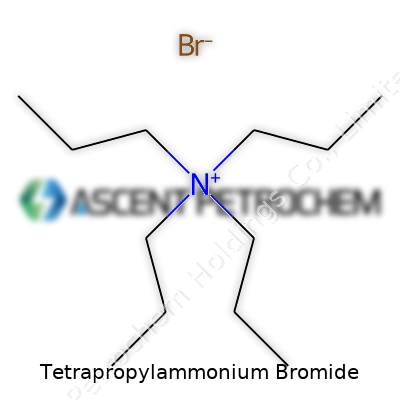
Most people walking into a lab would see a bottle labeled “Tetrapropylammonium Bromide” and move on. Few pause to dig deeper—yet this compound plays a surprisingly wide role in research and industry. With a structure made from one nitrogen atom surrounded by four propyl groups and an attached bromide ion, it lives up to the reputation quaternary ammonium salts have built in organic synthesis, nanotechnology, and material science. Over the years, hands-on work with this compound shows how it quietly acts as a powerhouse behind reactions and innovations beyond textbooks.
Tetrapropylammonium Bromide regularly steps onto the stage as a phase-transfer catalyst. In plain language, that means it helps chemicals that usually can’t mix or react, find common ground. Say you’re working with a reaction where organic and inorganic chemicals refuse to cooperate—the bromide steps in as a bridge. Suddenly, stubborn reactants transfer from water into organic solvents, opening the door for key reactions. In the making of certain pharmaceuticals or polymers, shaving hours or days off a reaction schedule can mean big cost savings. Many who have worked with interfacial chemistry at scale have reached for similar quaternary ammonium salts because they keep projects affordable and manageable.
Chemists crafting molecular sieves, such as zeolites, recognize the knack Tetrapropylammonium Bromide has for directing structure. The compound acts as a “structure-directing agent,” which, in practice, means that it helps form the crystal pores and tunnels that zeolite materials need for their filtration or catalytic tasks. Without the right directing agent, these crystals warp or simply fail to appear. Zeolites serve as the backbone for gasoline refining, pollution control, and even some detergents. Reliable synthesis keeps costs down and performance up.
In electrochemical research, such as work with batteries or supercapacitors, Tetrapropylammonium Bromide provides a steady supporting electrolyte. Stability matters. You want an ion that won’t react strangely or degrade your setup. Solid academic and field reports show the compound helps deliver repeatable, honest results from sensitive electrochemical experiments. Without these, engineers would fly blind building next-generation batteries or water treatment cells.
No matter which role it fills, safe handling always stays at the top of the checklist. The bromide ion, in combination with ammonium compounds, presents some toxicity risk if mishandled. While it doesn’t spark headlines like other industrial chemicals, anyone with real lab experience takes protective gear and proper disposal protocols seriously. Mistakes here can cost health or even land community fines.
Green chemistry continues to drive inventors to search for less hazardous alternatives. Researchers aim to swap in bio-based or less toxic phase-transfer catalysts, but few match the efficiency and reliability Tetrapropylammonium Bromide offers. For now, education, strict adherence to handling standards, and ongoing research into substitutes shape the path forward. Labs and refineries looking to cut waste and environmental impact focus not just on replacing the chemical but on rethinking processes from top to bottom.
In the end, Tetrapropylammonium Bromide stands as a workhorse in modern research and industry—helpful, powerful, and deserving respect, both as a scientific tool and a responsibility.Anyone who’s stepped foot in a chemistry lab or works with organic synthesis tools likely comes across compounds like tetrapropylammonium bromide. This mouthful of a name boils down to something straightforward: a salt made by joining a big organic cation to a bromide anion. The formula is C12H28BrN. If you read this off a bottle or an MSDS, you’ll realize those numbers add up to twelve carbons, twenty-eight hydrogens, one bromine, and one nitrogen—no surprise considering “tetra” means four and “propyl” means three carbons in a row for each attached group.
I remember the first time I drew tetrapropylammonium’s structure. I started with a nitrogen atom in the middle. Four propyl chains stick out of it, each one unbranched: –CH2CH2CH3. It’s a proper quaternary ammonium salt, which means the nitrogen sits fully surrounded by those alkyl groups and carries a positive charge. The bromide ion, Br-, does its job as a counterion but drifts away once tetrapropylammonium gets tossed into water or certain organic solvents.
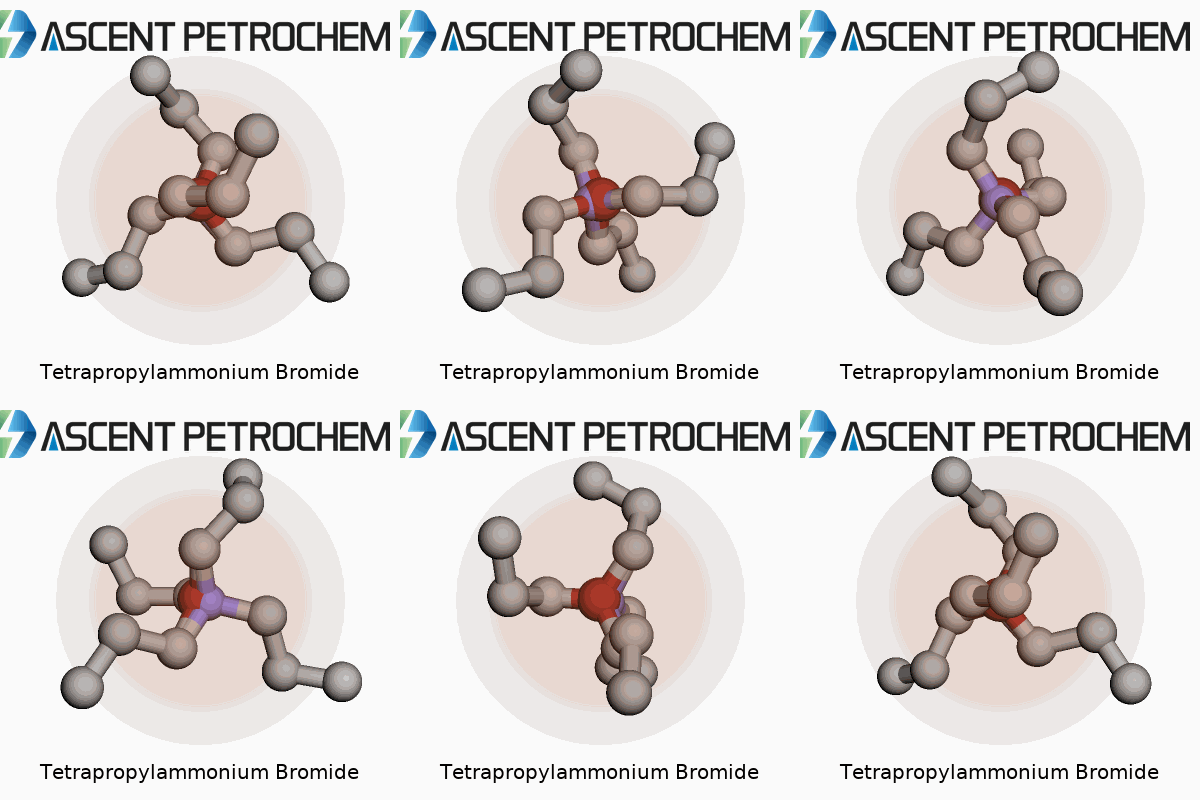
The geometry of this molecule shapes its properties. Quaternary ammonium compounds, with their bulky, greasy arms, don’t mix easily with polar water—and yet, they dissolve quite well thanks to that positive charge. That’s one reason chemists like myself rely on these salts when working on phase transfer reactions, where you want something to negotiate between oily and watery layers in a beaker.
Tetrapropylammonium bromide isn’t just textbook filler. It turns up in real-world experiments and industries. I have seen it playing a crucial role in making zeolites, the minerals that help refine petroleum and clean up wastewater. This salt serves as a template, drawing aluminosilicate fragments into the right order so crystals form with the needed holes and channels. If the ammonium wasn’t so bulky, these structures wouldn’t come out right, so these propyl chains matter more than people think.
Familiarity with the chemical formula matters here. A researcher checks if that sum formula fits their recipe before they mix. Errors in a lab sometimes come down to confusing tetrapropylammonium bromide with the tetraethyl or tetrabutyl cousins, where a swap changes molecule size, solubility, and all sorts of downstream effects. Sometimes young students think any quaternary ammonium salt will do. My own early mistakes taught me that close attention to chain length can make or break an experiment.
Safety teams like to remind everyone that the chemical’s structure isn’t just an idle detail. The four chained ammonium cations behave differently than simpler salts, interacting with cell membranes and biological systems in ways that can influence toxicity. Proper handling, storage, and disposal remain essential, and understanding what goes on at the molecular level spells the difference between a small spill and a real hazard. Environmental specialists keep a sharp eye on where these compounds end up after lab use; their persistence can raise concerns.
Knowing tetrapropylammonium bromide’s formula and structure gives a solid foundation for safe and intentional chemistry. It’s not just a jumble of letters and numbers. This knowledge helps pick the right molecule for the job, encourages safer work practices, and opens up a better understanding of how industrial and research processes build on small but important molecular changes. Careful observation and respect for these fundamentals have always served me well—and the same holds true for anyone hoping to do good science.
Tetrapropylammonium bromide often shows up in chemistry labs, especially in organic synthesis and as a phase-transfer catalyst. You don’t find it sitting around the house or floating through city air, but it exists in a range of academic and industrial settings where researchers value its unique chemical properties. Even though you won’t see it on a pharmacy shelf, the question of toxicity matters. Chemicals can make life easier, but safety never takes a backseat.
The safety data on tetrapropylammonium bromide leaves little room for comfort. Some chemicals seem invisible in their effects, but this one comes with skin and eye irritation warnings at relatively low exposure. Breathing in its dust can bother your respiratory system. Unlike salt or sugar, you can’t pretend this compound is harmless if spilled. The Material Safety Data Sheet (MSDS) details acute toxicity, and animal studies report moderate oral toxicity. No well-controlled studies investigate cancer risk or long-term side effects in people, but that gap doesn’t give a free pass. Often, absence of data equals absence of awareness, not absence of danger.
Lab benches may look tidy after cleanup, but chemical runoff and improper disposal threaten more than just workers in a white coat. Tetrapropylammonium bromide sticks in soil and water, with no easy way out once it enters the ecosystem. Marine life and aquatic environments especially struggle with persistent chemicals that resist natural breakdown. Fish and shrimp living in affected areas show stress markers and changes in cell structure—those impacts can climb up the food chain to humans sooner or later.
Early in my career, I processed samples in an analytical lab. One day, I misread a label and spent the afternoon dealing with a minor chemical splash. The lab’s safety officer drilled into us: know every bottle’s hazards and watch disposal protocols like a hawk. A slip on one compound might mean irritated skin, but another could affect your lungs or liver if you let your guard down. Tetrapropylammonium bromide belongs to the sort of chemicals that don’t forgive mistakes or carelessness.
Real safety comes from combination—personal responsibility, workplace systems, and updated knowledge. Wearing gloves and goggles always proves worth the hassle. Fume hoods do more than blow air around; they catch stray dust and keep your lungs strong long term. Well-marked disposal bins and collection systems give leftover chemicals a safe end, protecting workers and the groundwater outside. Companies and universities need regular training refreshers so people remember the reality behind hazard labels. Even small batch manufacturers or school chemistry clubs should invest in cleaner alternatives—or at least minimize their stockpiles and stick to updated protocols.
Some chemists work hard on green chemistry alternatives. Quaternary ammonium compounds can sometimes be replaced with less persistent or less harmful reagents, which keeps the need for strong control measures lower. Until that shift becomes widespread, strict observance of safety advice remains essential. Those working with tetrapropylammonium bromide must treat it with respect: gloves on, waste managed, and spills handled like the real hazards they are.
Years of experience in chemical labs teach lessons no textbook covers. Tetrapropylammonium bromide has its place as a key compound in organic synthesis and advanced material development, but its longevities, both in terms of shelf life and safety, depend on more than just sealing the bottle. You don’t toss this kind of chemical on a shelf tucked between some old glassware and think the job’s done.
Colleagues trading stories in the break room always circle back to storage—how small oversights create large headaches. This compound flourishes with dry, room-temperature storage. Humidity turns an easy day into confusion and extra lab work since moisture triggers clumping. Even worse, you face unknown risks with hydrolysis. Basic tips—use an air-tight container, label the date of receipt, and put it somewhere away from all the acids and oxidizers. These habits aren’t busywork. A forgotten open cap leads to ruined batches, unpredictable outcomes, and financial losses when replacements sit in the queue.
No matter how experienced you feel, there’s no excuse for ditching gloves. Skin exposure is an open invitation for irritation, and you can’t always trust a safety data sheet to warn about everything. I watch new lab techs shy away from goggles during prep work—nobody remembers the splash after the reaction kicks in, only how much it stings. Eye protection, lab coats, and gloves cut down on risk so everyone clocks out safely at day’s end.
There’s also the temptation to mix small compound quantities on open benches, especially during routine syntheses or late-night sessions. Even a careful worker can scatter dust or spill drops. fume hoods and trays might look like barriers, but they bring peace of mind and cleaner benches. Those who skip these best practices gamble with more than just their safety.
These chemicals aren’t just “materials”—they’re responsibility packaged up in bottles and jars. Mishandling means unnecessary expense or exposure, and nobody wants the call from a safety officer since someone ignored protocol. My time handling routine shipments taught me to check for damaged bottles and leaks; a stain unnoticed at delivery can lead to sticky messes a week later.
A surprising fact: many reported lab accidents don’t actually involve large-scale reactions—they happen during small, careless tasks. Sifting through incident reports, clear trends pop up. Labels peel off, old containers crack, people underestimate the time they’ll spend working with a chemical or forget where they last used it. All these stem from undermining the basics.
The solutions aren’t flashy. Keep inventory tight, rotate stock, and assign one person every month to verify condition and sealing. Use dedicated storage separate from strong reagents, discard anything past expiration, and document every move. Share stories and mistakes during team meetings. Most mishaps lose their steam the moment someone speaks up and others listen.
Good science doesn’t just happen in controlled reaction vessels. It shows up in the daily decisions around storage, handling, and discipline. Tetrapropylammonium bromide doesn’t ask much: just attention and a commitment to safety that doesn’t fade, even when no supervisor’s watching.
In the world of specialty chemicals, Tetrapropylammonium Bromide often turns up in synthesis, research, and even industrial processes. Purity isn't just a technical number for folks working at the bench. Researchers depend on knowing the exact quality to get consistent results, either for the next step in a multi-part reaction or for scaling up something that started out as a curiosity on a small scale.
For Tetrapropylammonium Bromide, chemists look for a purity specification of at least 98%. If the task calls for extra sensitivity, some suppliers push up to 99% or even 99.5%. These numbers reflect what’s left behind after distillation, crystallization, and a lot of quality control. Anything lower brings risk to delicate reactions—the kind that can fail with only a hint of impurity, especially in pharmaceutical or electronics research.
Quality control specialists don’t stop at a percentage on the label. Top suppliers back their claims with certificates of analysis, often giving more detail than most folks ever read. That includes water content, residue on ignition, and trace metals. A researcher with experience will tell you: cutting corners on purity saves trouble in the short run, but problems pile up fast down the road. A single failed synthesis can cost days or weeks of lost work.
Scientists rarely need to buy more than they can handle safely. Many chemical companies offer Tetrapropylammonium Bromide in bottles starting around 25 grams. That’s enough to run a set of experiments, confirm a reaction, or develop a protocol. Academic labs and startups thrive on these smaller options since budgets often don’t stretch to bulk buying or storage of hazardous materials.
Engineers and process chemists, on the other hand, often request 100-gram or 500-gram containers, sometimes even a kilogram or more. Moving up to larger sizes makes sense when a process moves out of the flask and into manufacturing. At that level, packaging tends to shift to heavy-gauge plastic or sturdy drums. Handling also changes—no more scooping powder by hand—and safety takes a front seat because exposure risks increase.
Those in purchasing roles learn fast that the packaging matters for more than just price per kilo. Clumsy packaging can lead to spills or wasted material. Moisture-sensitive compounds, in particular, must ship in containers that keep out air and water, sometimes even under nitrogen. If that step gets skipped, an entire lot can get ruined before it even reaches the user.
It’s tempting to go with the lowest-cost option, but for those tasked with keeping a lab running, reliability from chemical suppliers matters more than saving a few dollars. Vendors who can prove the track record for both purity and secure packaging usually win repeat business. In some industries, regular auditing keeps everyone honest, but in smaller operations, people rely on recommendations and hard-earned experience.
As safety and compliance rules have grown tighter, companies have put more thought into both what goes in the bottle and how it gets delivered. Modern packaging lines often feature tamper-evident seals, clear labeling, and batch tracking. These practices help limit errors and keep everyone safe. As research needs become more complex, demand grows for both higher quality and smarter, safer packaging.
Having spent time in both academic and industry labs, I’ve seen rushed buying decisions lead to delays, botched results, and extra red tape with regulators. The most effective research groups treat purity specs and packaging as investments, not just compliance. Tetrapropylammonium Bromide might look like a simple white powder, but the way it arrives in the lab can set the tone for the whole project. For those looking to avoid missed deadlines and budget headaches, clear communication with trusted suppliers makes a world of difference.