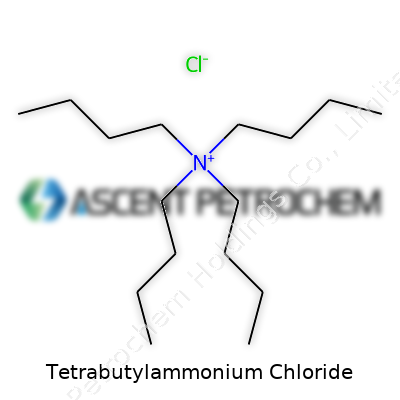
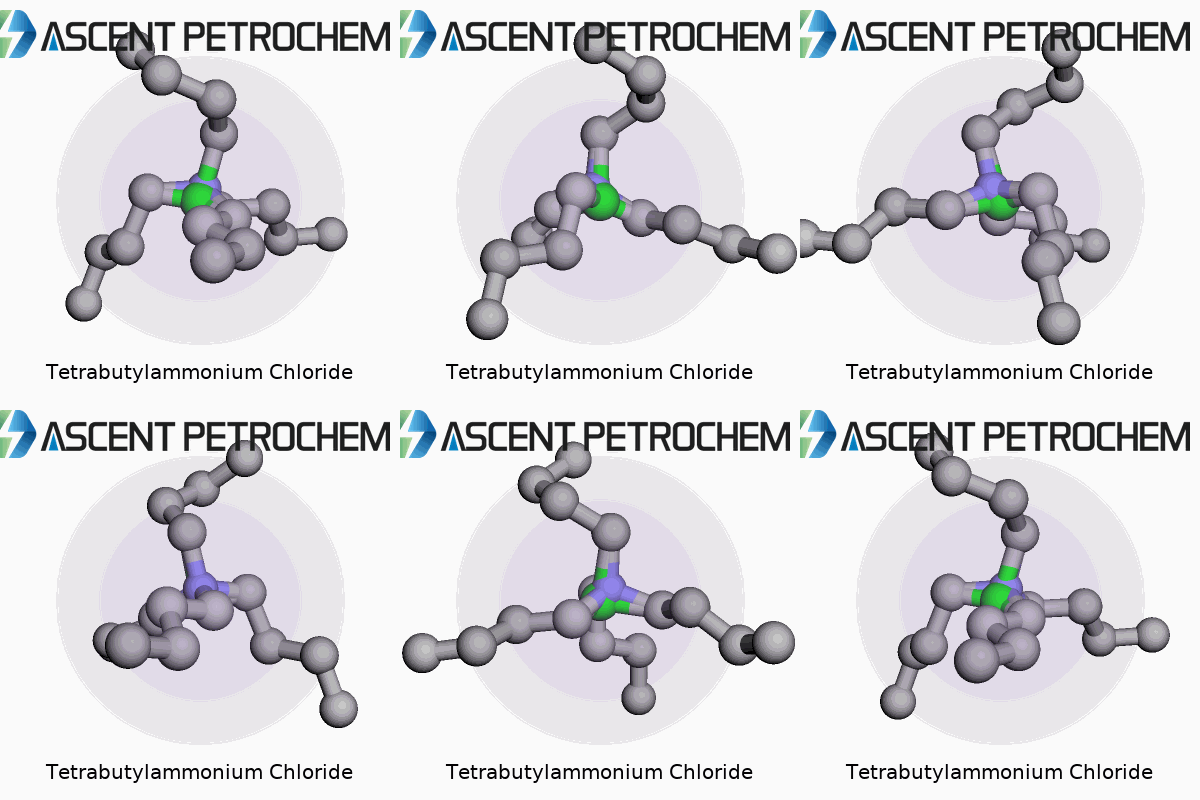
Interest in quaternary ammonium salts shot up in the twentieth century, and Tetrabutylammonium chloride (TBAC) came out of that surge. Early chemists studied ammonium compounds because these molecules bridged organic and inorganic worlds. TBAC turned out to be a workhorse in labs focused on organic synthesis, especially as people realized just how much it could change solubility and reaction speed. My days in university research labs often revolved around this compound when carrying out phase-transfer catalysis, and even decades later, batches of TBAC remain a familiar sight on chemical shelves. Development followed a steady path, moving from basic lab curiosity into a practical compound with wide industrial reach. Common patents from the 1970s and 1980s laid down the groundwork, making TBAC an essential item for chemists and manufacturers alike, supporting two generations of innovation in custom synthesis and industrial scale-up.
Tetrabutylammonium chloride pops up as a white crystalline solid, usually stable under normal storage. Chemical producers offer it at various grades, catering to different levels of purity for research or industrial runs. It owes its popularity partly to versatility—workflows from the chemical industry to pharmaceuticals know TBAC as a reliable quaternary ammonium salt. Talking to fellow chemists, I learned that most find TBAC easy to dissolve in common solvents and appreciate that it stands up to repeated handling, even when humidity in the workplace is less than ideal.
Chemically speaking, TBAC carries the formula (C4H9)4NCl, which gives it both a sizeable hydrophobic region and a charged center. That balance affects solubility, making it ideal for phase-transfer catalysis. The compound melts at about 37–39°C—not far off room temperature—so it can feel waxy if it warms up a bit on a bench top. It dissolves fast in organic solvents like chloroform or acetone, and mixes well with water. As a solid, it does not have a strong odor. TBAC does not explode or burst into flame under typical handling, although it breaks down above a few hundred degrees Celsius, as most organics do.
Sellers list the molecular weight at roughly 277.9 g/mol. Commercial bottles usually show purity levels, which range from technical grade in bulk form to high-purity grades suitable for high-stakes research. Labels include instructions on safe storage: cool, dry places, away from strong acids. Over the years, I learned to check for labeling on moisture content because TBAC absorbs water from the air, which can throw off weights or affect reactions. Suppliers give a lot number for traceability, and SDS sheets outline hazards and emergency steps, matching strict chemical regulations.
Manufacturers make TBAC by reacting tetrabutylammonium hydroxide with hydrochloric acid in water. The byproduct is usually just water, so this process leaves behind a relatively pure salt that can be filtered, washed, and dried before packaging. If you ever try making it in a lab, the strong smell of butyl groups drifts out as you stir the mix, but the end result comes out clean. On an industrial scale, automated systems keep air and moisture at bay, since freshly made TBAC soaks up water if it gets the chance. Filtration and thorough drying prove key to getting a product that meets chemical industry standards.
TBAC gets a starring role as a phase-transfer catalyst. I remember running biphasic reactions that simply would not go without it—the cation slips into the organic phase, carrying ions like chloride or hydroxide, and suddenly the reaction kicks off. Besides catalysis, TBAC reacts with silver nitrate to make tetrabutylammonium nitrate, and can participate in ion-exchange reactions that give access to other quaternary ammonium salts. People sometimes use it to generate N-butyl derivatives or as a bulky counterion in analytical chemistry. Modification routes might replace the chloride, swapping in other anions and thus tailoring the properties for specific tasks, such as halide abstraction or ion-pairing in NMR studies.
Chemical suppliers keep it simple. You see names like TBACl, N,N,N-tributylbutan-1-aminium chloride, or just tetrabutylammonium chloride. Alternate spellings and abbreviations show up, but all point to the same essential stuff. Different brands stand behind their handling and purity, so one researcher’s TBACl might come from Sigma-Aldrich, another from Alfa Aesar, but the label content is nearly always consistent to avoid confusion in critical synthesis work.
TBAC doesn’t strike fear into chemists, but it earns its safety labels. Direct contact can cause skin and eye irritation, so gloves and goggles belong in the toolkit. I remember a spill on my bare wrist that felt slightly oily at first, but developed some redness—washing thoroughly kept it minor. Regulatory agencies place it under the same umbrella as other lab chemicals: don’t eat, drink, or breathe the dust. Fume hoods help reduce risk if large quantities get involved. Disposal requires attention—local waste rules direct TBAC residues to suitable chemical waste containers, not the drain. In commercial settings, operators run checks for airborne dust and stick to exposure limits based on workplace guidelines.
TBAC shows up wherever chemists need phase-transfer catalysis or ion exchange. I’ve seen it in processes that bring together water-soluble and oil-soluble reactants, which rarely mix on their own. Industrial makers of pharmaceuticals and agrochemicals use it for tough bond-forming reactions, especially for alkylation or halide exchange, that stall without help. Analytical chemists employ it to coax out ions during titrations, or as a standard to check instrument calibration. Even battery researchers and folks in polymer science keep TBAC on hand, looking for efficient salt pairs that can withstand a range of solvent environments or support unusual reaction pathways.
Every decade brings new uses for TBAC. Recent science journals talk about its role in greener solvents and ionic liquids. Researchers now grow interested in swapping halides efficiently, designing tailored cations for drug delivery, or using TBAC structures in nanotechnology. In my own work, collaboration often led to testing TBAC alongside related salts to see which gave the cleanest conversion without generating mystery byproducts. That real-life trial and error paved the way for published methods and set the standard for checking new synthetic routes. Research teams focus as much on practical handling as on underlying theory, because moisture control, storage, and purity still make or break many proposed reactions.
TBAC is not among the most toxic chemicals in the lab, but a healthy respect keeps problems at bay. Animal studies and safety reviews usually show low acute oral toxicity, but longer-term exposure raises concerns about potential impacts on organs or aquatic environments if released without treatment. I always check the latest safety bulletins for any changes in these findings—it pays to stay up-to-date, especially since large-scale users need to track worker health and local emissions. Eco-toxicology studies in recent years have flagged persistent residues in waterways, driving calls for better waste management. Standard lab practice leans toward caution, using closed systems and sealed waste to prevent unnecessary exposure.
The chemical industry is seeing a push for greener, more sustainable methods, and TBAC offers advantages as a low-volatility, reusable component in many transformations. Startups are looking for ways to recycle or regenerate TBAC from reaction mixtures, aiming to reduce waste. I’ve watched process chemists redesign older synthesis pathways to eliminate more hazardous phase transfer catalysts, and TBAC often ranks near the top for safety and cost-effectiveness in these comparisons. Ongoing research in materials science—especially for advanced batteries and organic electronics—depends on salts like TBAC for experimental electrolyte blends. With each breakthrough in catalyst science or ionic material design, TBAC’s role grows, pointing to a busy future for this not-so-humble quaternary ammonium salt.
Tetrabutylammonium chloride shows up in a lot of labs, but most people don't ever hear its name. Sometimes people think of chemistry as something far off, but this compound impacts plenty of everyday processes and industries. Looking at a bottle of this stuff brings back memories of long hours in the lab, mixing up solutions that nobody would ever see—or so I thought. Turns out, a lot rides on what happens in those glass beakers.
This compound likes to help: it serves as a phase-transfer catalyst. In plain terms, it makes it easier for ingredients that don’t mix—water-based and oil-based stuff—to come together and react. Anyone who’s tried mixing oil and water knows a struggle, but tetrabutylammonium chloride gets those reactions moving. In my university days, we always reached for it in organic synthesis when stuck. The results fed into the next day’s experiments, bridging one problem to another solution.
People working in manufacturing rely on this compound too. Large-scale producers use it for making pharmaceuticals, plastics, and even coatings. Bringing different ingredients together cuts down on wasted starting materials. Efficiency like that means less energy used, and sometimes less waste poured down the drain. That story shows up not just in cleaner chemistry, but in money saved for the company and safer air and water for the rest of us.
Anyone working in environmental monitoring or food testing may have seen this compound help out in ion-pair chromatography. Cutting-edge equipment depends on separation done right, and tetrabutylammonium chloride steps in to wrangle tough cases—one more example of chemistry improving how we keep our water or food safe. Clients from the regulatory side appreciate reliable instruments, but they probably never ask about the small boost this salt brings to those tests. They care about results, not the behind-the-scenes helpers.
The other side of the story always comes up in chemical circles: what’s the flip side of wide use? Safety isn’t a given. Proper storage and handling stay important. Spilling some sounds harmless, but a floor covered with this can cause slips, not to mention possible irritation if inhaled as dust. Waste management in the lab and factory deserves more respect too. Dumping leftover chemicals can add to pollution if not handled right. Teams following safety rules and keeping good records cut down on risks both to themselves and the environment.
Chemists keep looking for greener ways to reach the same results. Sometimes an alternative catalyst works with less risk; other times, the industry has to stick with what works but find tighter ways to control use, storage, and recycling. Each choice in the lab affects bigger choices down the supply line. From graduate labs to big factories, good habits and smart substitutes keep things safer for the people who never see the chemical names—just the finished products in their hands.
Tetrabutylammonium chloride has the formula C16H36ClN. On paper, it seems like just one more chemical among thousands, but for anyone who has worked in a chemistry lab, the name rings a bell. Four butyl groups (each with four carbons and nine hydrogens) hang off a central nitrogen, giving it a rather bulky structure. Pair that big organic cation with a single chloride anion, and you get a chemical that pops up far outside of textbooks.
Chemical names sound intimidating, but tetrabutylammonium chloride does a lot of heavy lifting in research. Chemists use it as a phase-transfer catalyst. In plain speak, that means it helps chemicals that don’t usually mix—like oil and water—interact with each other. I remember sitting in my university’s organic chemistry lab, watching an experiment go nowhere until we added this compound. Suddenly, reactants that refused to shake hands started working together, the reaction rate shot up, and lab partners stopped glaring at the clock.
Outside academic work, tetrabutylammonium chloride shows up in real products. It helps in drug synthesis, making medicines cheaper to produce and purer. Some folks might handle it while making custom compounds for electronics, or in cleaner conversions for industrial waste. It’s not dangerous if someone handles it carefully, but it’s also not the sort of thing to leave lying around the kitchen.
The structure of tetrabutylammonium chloride explains a lot about its behavior. That chunky cation loves to dissolve in organic solvents, which gives chemists an advantage: it can drag ions out of water into oils or organic liquids. With the current push for greener, safer chemistry, this beats other approaches that need harsh, polluting conditions. In my own work, switching to phase-transfer catalysts cut down on the nasty smells and chemical waste in the fume hood. Fewer headaches, fewer disposal problems.
Despite its utility, there’s a need for respect in the lab. While it’s not as hazardous as old-school chemicals like carbon tetrachloride, it's not entirely benign. Spills still require gloves and goggles. Eye contact burns, and long exposure can irritate skin or lungs. I’ve seen labs lock up their supplies and double-check the Material Safety Data Sheets—habits worth copying.
Some people see chemicals only as pollutants or hazards, but knowledge about compounds like tetrabutylammonium chloride lets research push forward with less waste. Companies look for chemicals that boost yields, save money, and leave behind fewer toxic leftovers. By focusing on greener phase-transfer chemistry, the next generation of scientists step closer to safer everyday products—fewer side effects in medicine, safer materials in electronics, and less junk released into the environment.
Knowing which formula belongs to which compound does more than win trivia contests. It drives innovation in labs, raises safety standards, and moves everyday products toward a cleaner footprint.
Tetrabutylammonium chloride doesn’t spark headlines, but anyone who spends time in a lab knows the headache one spilled jar can bring. I once worked in a chemical stockroom where a careless shelf arrangement caused a dozen containers to tumble down in a single afternoon. Cleaning up posed a bigger problem than grabbing a mop—some chemicals react, others soak into the tile, and many, like tetrabutylammonium chloride, demand a plan well ahead of any mistake. In almost every university and industrial lab, practicality beats theory: safe storage starts with clear labeling and a steady check on conditions.
Most folks working with tetrabutylammonium chloride treat temperature control as standard. Nobody wants a white crystalline solid clumping or turning mushy. This compound holds up best at room temperatures, somewhere around 15–25°C. Freezers bring condensation, while direct sunlight might break down the container or stress the seal. High humidity in the stockroom spells trouble—tetrabutylammonium chloride reacts with water in the air and slowly loses its strength. Using desiccators or sealed cabinets does more good here than fancy engineering controls ever will.
I once found a container covered in powder at the rim and realized the cap wasn’t tight. Good containers save more time and frustration than the fanciest safety audit. Always pick glass or polyethylene bottles that seal tight. Dodge metal containers or any packaging that shows signs of rust or warping—chloride ions chew through certain metals over time. Older labs, especially, sometimes reuse containers out of habit. This shortcut can trigger cross-contamination or leave chemical residue behind. Keep a weekly habit of checking seals and swapping cracked caps.
Textbooks stress labels but working in a fast-paced environment reveals how easy it is to stash an unlabeled bottle on a crowded shelf. Labels printed in permanent ink, showing both the full chemical name and concentration, leave no room for mistakes. Include the date opened and a hazard symbol—simple details that save lives during routine checks or emergencies. Try walking into a stockroom with faded or missing labels and see how quickly uncertainty grinds workflow to a halt.
Mixed-shelf storage causes more close calls than most labs report. Tetrabutylammonium chloride should not sit with oxidizers or strong acids—combine those by accident, and you’ve got a violent reaction. Assign dedicated spots; never ignore this. It pays to map out your shelving layout. Dangerous pairings crop up when delivery comes late, or shelves fill up, but sticking stubbornly to your original system makes all the difference. Chemical storage guides from suppliers and regulatory agencies like OSHA don’t read like fiction—they’re written in blood and burns from past neglect.
Leaving gloves on when grabbing bottles, propping open doors, or turning off fume hoods to save electricity all make sense in a rush. But these shortcuts pile up risk. Build routines—wash hands and close bottles after every use. Spill kits and showers only work if staff drill on their location and use. Auditors look for paperwork, but lived experience shows that the muscle memory of safe handling outweighs any checklist.
Good habits come from hands-on mentorship, not policy binders. New hires or students should shadow someone seasoned before organizing those chemicals alone. My first week in research, I watched a seasoned technician talk through each decision while restocking the shelves. That memory stuck with me far better than reading a dozen pages of safety manual. Tetrabutylammonium chloride may not make the news, but treating its storage as an everyday priority shows a lab values both its people and its science.
Working in a chemistry lab, I’ve crossed paths with Tetrabutylammonium chloride plenty of times. This chemical appears on supply shelves everywhere, typically used as a phase-transfer catalyst. Many folks outside a research or manufacturing environment might not recognize its name. Still, once it enters the workspace, the risk factors deserve a close look.
Tetrabutylammonium chloride can irritate the skin and eyes. Touching a solution or a powder without wearing gloves can cause redness, itching, and discomfort. Eye splashes sting badly. I recall an incident during my graduate days when a classmate mixed compounds a bit too briskly and caught some fumes—his eyes ran for half a day. Not exactly a welcoming introduction to the substance.
Inhaling dust from this chemical isn't wise, either. It may cause irritation in the nose and throat. People exposed to its vapors often complain about coughing or a scratchy throat. That’s not unique to this compound, but because it doesn’t have a strong warning odor, you might inhale more than you’d think. Masking up and venting the workspace stays non-negotiable for good reason.
Consistent contact with Tetrabutylammonium chloride hasn't been studied in humans as deeply as some industrial chemicals, but animal studies point to clear risks. Prolonged exposure can stress the liver and kidneys. There’s evidence that chronic inhalation or skin absorption may trigger problems beyond everyday irritation. Workers in industries using this compound often get yearly medical checkups to spot any early warning signs.
Ingesting any significant amount brings bigger dangers. Swallowing the powder or making a mistake while pipetting puts the nervous system and digestive tract at serious risk. Call poison control, not Google, if this goes wrong; symptoms can escalate fast.
Many countries regulate chemicals like Tetrabutylammonium chloride through workplace safety standards. The U.S. Occupational Safety and Health Administration (OSHA) and European agencies recommend using gloves, goggles, and protective clothing. Storing it in properly labeled containers keeps accidents minimal.
This responsibility stretches beyond the lab. Shipping accidents, improper storage, or careless disposal can put communities at risk. Once, I saw a spill during transport between buildings. Because the containers were double-bagged and labeled, emergency cleanup teams responded quickly and safely blocked the area. Simple steps like these often prevent the worst outcomes.
For science geeks hungry to cut risk, green chemistry offers new catalysts that work in water and break down faster in the environment. Several companies have started phasing out older reagents in favor of less persistent chemicals. Even traditional labs are slowly upgrading to work with solvents and agents that don’t leave lasting harm.
Building a culture of safety means training new chemists and industry workers to respect every substance, not just those with skull-and-crossbones labels. We don’t need paranoia, just knowledge and steady habits. A safe environment relies on honest conversations about which chemicals need extra caution, straightforward data from toxicologists, and a willingness to try something better when science comes up with it.
Working in a lab, Tetrabutylammonium chloride comes up as a common guest–especially if you're neck-deep in organic synthesis or separation science. Folks pick this compound because it deals well with a whole range of solvents, most notably water and polar organics like methanol, ethanol, and acetonitrile. That kind of adaptability doesn’t show up often. Many organic salts struggle to blend into water, but this one doesn’t give much trouble. Drop TBACl into a beaker of water and watch it dissolve with little fuss.
The four butyl groups attached to the nitrogen make the cation big and soft, giving this salt high solubility across both polar and certain non-polar solvents. In my own experience, using it as a phase-transfer catalyst or ionic medium, it rarely leaves clumps at the bottom of the flask. Water does a fantastic job—TBACl dissolves fast and easy at room temperature, forming clear solutions that help reactions tick along without mysterious delays. With solvents like dimethyl sulfoxide (DMSO) or N,N-dimethylformamide (DMF), you're also in safe territory; the salt mixes smoothly.
Nobody likes waiting for a solid to dissolve when time and precision matter. Tetrabutylammonium chloride earned its reputation in labs precisely because chemists don’t have to fight with it. For instance, in nucleophilic substitution reactions, the salt plays the role of a phase-transfer agent. Organic molecules and aqueous ions often refuse to mingle, so you need something that bridges the gap. TBACl, thanks to its solid solubility and ionic properties, gets that job done. It shuttles ions across phase boundaries so reagents actually interact, not just swim past each other.
Electrochemists lean on TBACl too. In non-aqueous solvents, maintaining enough ionic strength without clogging up electrodes or clouding the solution keeps measurements precise. Here, the solubility not only boosts efficiency but keeps results reproducible. If you’ve ever run a cyclic voltammetry experiment with a less-soluble salt, you know the struggle—grainy mixtures, scattered data, wasted time.
Plenty of lab reagents raise waste disposal questions, especially those that linger in water. TBACl’s high solubility means it doesn’t just sit in glassware after an experiment, so washing up takes less energy and fewer solvents. That matters for both efficiency and safety: nobody relishes scrubbing hazardous residues. Of course, being soluble in water has a flipside—if it escapes the lab, it won’t stick around on the ground for long but could impact local waterways. Responsible disposal and wastewater management need strict attention. Labs can install activated carbon filters and opt for closed-loop water systems to ease environmental risks.
Researchers continue searching for greener alternatives and improved recycling methods, both for TBACl and for the solvents it thrives in. Fact remains, though: when speed and reliability matter, its solubility cuts out a host of headaches. Sharing best practices and staying up to date on new handling protocols ensures TBACl stays an ally, not an overlooked hazard.