The story of tetrabutylammonium bromide stretches back to the expansion of organometallic and quaternary ammonium chemistry during the twentieth century. Research labs in the 1950s needed novel phase transfer catalysts for making complex organic transformations more accessible. The push for more sustainable and efficient chemical processes fostered development and commercial production of compounds like tetrabutylammonium bromide. Scientific research picked up on its unique properties and labs across the world began adding this salt to their toolkits. Growing demand across synthetic, analytical, and industrial chemistry underlined its usefulness.
Tetrabutylammonium bromide, a quaternary ammonium compound, shows up in labs as a white crystalline powder or colorless crystals. It has drawn continuous interest for its solubility in both polar and nonpolar solvents, thanks to its bulky, hydrophobic butyl groups paired with a bromide counterion. Its chemical nature opens up routes for both phase transfer catalysis and organic synthesis. With roots in the organics field, this compound supports a range of applications—acting as a phase transfer catalyst, an ion-pairing agent, and a precursor for more specialized ammonium salts.
With a chemical formula of C16H36NBr, tetrabutylammonium bromide weighs in at 322.37 g/mol. In ambient conditions, it appears as a white or sometimes slightly off-white crystalline solid. It dissolves well in water and many organic solvents, making it versatile for various laboratory set-ups. The melting point hovers around 102-104°C. It stays stable under normal storage conditions, but it reacts with strong oxidizing agents and should be kept away from sources of ignition. Unlike many simple salts, its bulk and hydrophobicity make it uniquely valuable in solvent–solvent interfaces.
The technical grade typically boasts a purity above 99%. Most commercial suppliers list moisture content (usually below 0.5%), melting point, and specific optical rotation if applicable. Reliable labeling covers critical safety information, CAS number (1643-19-2), batch number, production and expiry date, and recommended storage conditions, often suggesting a cool, dry, and well-ventilated area. Compliance with regional and global chemical inventories offers reassurance to specialists sourcing raw material for scientific and industrial purposes.
Industrial production usually involves quaternization of tributylamine by reaction with 1-bromobutane, followed by purification and crystallization. Here, tributylamine and n-butyl bromide enter a reactor and react with heat under controlled conditions, producing tetrabutylammonium bromide as the major product. After washing, filtration, and drying, the compound comes out clean—pure enough for use in sensitive organic syntheses. The preparation ties into broader histories of ammonium chemistry and the drive for scalable, reliable synthesis.
As a phase transfer catalyst, tetrabutylammonium bromide enables reactions between species in different solvent phases. Scientists have leaned on it to drive nucleophilic substitutions, oxidations, reductions, and alkylations. Its quaternary ammonium core stays stable in many reaction conditions, leaving the bromide as a labile ion for exchange or reaction. With minor tweaks, chemists have swapped the bromide for other halides or even softer anions, giving rise to a library of ammonium salts with customized reactivity. Many students remember handling this compound during undergraduate experiments, often marveling at how much a simple salt can boost reaction rates and yields.
This compound circulates under names such as TBAB, tetrabutylammonium bromide, tetrabutylamine hydrobromide, and N,N,N-tributyl-1-butanaminium bromide. Chemical catalogs often use the abbreviation TBAB, not to be confused with related ammonium compounds featuring different chain lengths or halides. Each synonym points to a diverse application history, acting as a connecting point for chemists working across the synthetic, analytical, and industrial fields.
Direct exposure can irritate skin, eyes, and the respiratory tract. Safety data sheets recommend gloves, goggles, and lab coats during use. Longer exposures, inhalation, or accidental ingestion raise risks that should not be ignored. Laboratories bear the responsibility to maintain solid training and handling protocols, from labeling all containers to controlling dust and spills. Disposal procedures follow hazardous chemical waste rules in most countries, considering both the bromide content and the organic framework. From personal experience, following these regulations reduces accidents and sets a safe tone in any lab.
Scientists reach for tetrabutylammonium bromide most in phase transfer catalysis. This role comes to the fore in complex organic syntheses—think Williamson ether synthesis and nucleophilic substitutions—where reagents sit in separate phases and need help interacting. More recently, battery and electrochemical research has used TBAB as an electrolyte or supporting salt. Analytical chemists rely on ion-pairing agents like TBAB for improved chromatography of charged species. There’s no shortage of creative uses, and the ability of TBAB to move ions through awkward junctions forms the backbone of its utility.
Research journals offer a long list of reports leveraging TBAB for synthetic methods, catalyst development, and environmental remediation. Teams investigating greener chemistry methods often replace volatile organic solvents with water, and add TBAB to bring otherwise shy reactants together. Newer work looks at how modified quaternary ammonium salts—based on the TBAB backbone—can enhance separation membranes and drug delivery systems. Experts in this field keep looking for ways to tweak the structure, swap out the bromide, or introduce chiral centers, searching for better selectivity or bio-compatibility.
Toxicological studies have found that TBAB shows low acute toxicity in mammals, though prolonged or high-concentration exposure shows some detrimental effects, particularly due to the bromide ion. Researchers investigating aquatic toxicity note moderate risk to aquatic organisms, especially at high or persistent concentrations in wastewater. For humans, eye or skin contact usually brings only mild irritation, but ingestion or significant inhalation can carry risk. Following regulatory advice on limits and monitoring keeps workplace exposure well within safe boundaries. Environmental research in recent years has pushed for treatment options that limit release to waterways, ensuring TBAB supports progress without causing undue harm.
Looking ahead, improvements in green and sustainable chemistry will keep TBAB and its cousins in the spotlight. There’s clear demand for scalable, environmentally friendly catalysts and phase transfer agents. Engineers and chemists have already started designing derivatives that offer selectivity or lower ecological footprints. As computational chemistry models keep improving, it seems likely that TBAB will serve as a reference for the next wave of designer ammonium salts, optimized for safety, efficiency, and compatibility with new materials. Emerging energy storage and materials science fields will find new ways to use TBAB, linking modern industry with decades of fundamental and applied chemical research.
Tetrabutylammonium bromide, often shortened to TBAB, has become a staple in labs dealing with organic chemistry. Its main draw comes from acting like a helping hand during chemical reactions where oil and water wouldn’t normally mix. Most people fresh out of grad school remember TBAB as the “phase transfer catalyst” on their bench, making gritty mixtures finally do what the chemist wants. This compound moves ions across barriers, unblocking reactions that don’t want to start on their own. You see it listed in patents and academic papers all over the world, from the US to Asia.
In places where solvents fight each other, TBAB helps reactions proceed by making sure the right partners shake hands. Many pharmaceutical ingredients get synthesized this way. TBAB doesn’t just work in theory. Friends in industry like it because you don’t have to mess with weird solvents or fancy machines. Drop a bit of TBAB in, and stubborn chemicals finally cooperate. That’s a far cry from the days before these smart salts became widely available. As someone who struggled with “biphasic” reactions without a good catalyst, I saw how it cut down on wasted time and raw materials. Suddenly, yields improved, and purification smoothed out.
Lab bench chemistry isn’t the end of TBAB’s usefulness. Look outside the academic world, and TBAB powers up many industrial processes. It allows companies to make critical building blocks for everything from agrochemicals to dyes. Some electroplating outfits even use it to control the balance of ions, keeping their metal finishes smooth and reliable. Water-soluble with a knack for jumping between layers, TBAB speeds up tough reactions in commercial settings where downtime and loss can hurt a business.
Not everything about TBAB is rosy. While most scientists use small amounts, scaling up brings a new set of worries. Like a lot of chemicals handled in the lab, TBAB should never be dumped down the drain. Proper waste management matters. In my early years, I saw cases where careless disposal created headaches for wastewater treatment facilities. Protecting people and the environment calls for clear labeling, sturdy containers, and training so spills and exposure don’t happen. Chemical suppliers and end users need to follow rules set by agencies like the EPA to avoid risks.
TBAB is reliable, but it’s not the final answer. Research teams keep hunting for greener phase transfer catalysts. Some options cut down on toxicity and break down more easily after use. Using less hazardous catalysts saves money on cleanup and disposal. For smaller companies, that means fewer compliance nightmares and a lighter load on the environment. The shift to safer chemicals takes time, but progress shows in the growing number of alternatives popping up in literature and product catalogs.
Tetrabutylammonium bromide earns its spot on the shelf thanks to its dependability in both chemistry research and industry. It doesn’t steal the spotlight, but without it, modern chemical manufacturing would slow down and cost more. Many students remember TBAB from their first organic synthesis lesson, maybe frustrated but later grateful for its hidden power. To make chemistry cleaner and safer, the quest for better alternatives continues, but right now, TBAB does its job, quietly helping innovation reach the real world.
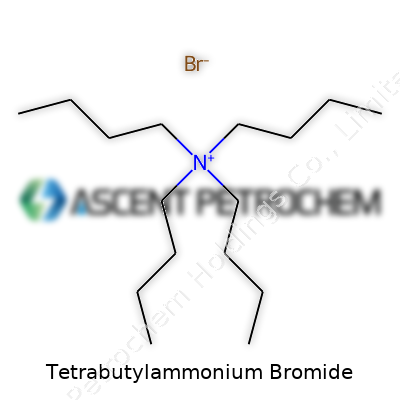
People who immersed themselves in chemistry classes probably remember the pieces: “tetra” means four, “butyl” points to a four-carbon chain, “ammonium” brings nitrogen into focus, and “bromide” refers to a simple bromine anion. Take those puzzle pieces, and you get a compound scientists and engineers recognize for its practical uses in labs and industry. The formula spells out like this: (C4H9)4NBr. You have four butyl groups attached to a single nitrogen, teamed with a bromide ion. Put that together, you can see why this salt works so well as a phase transfer catalyst and makes life easier for researchers.
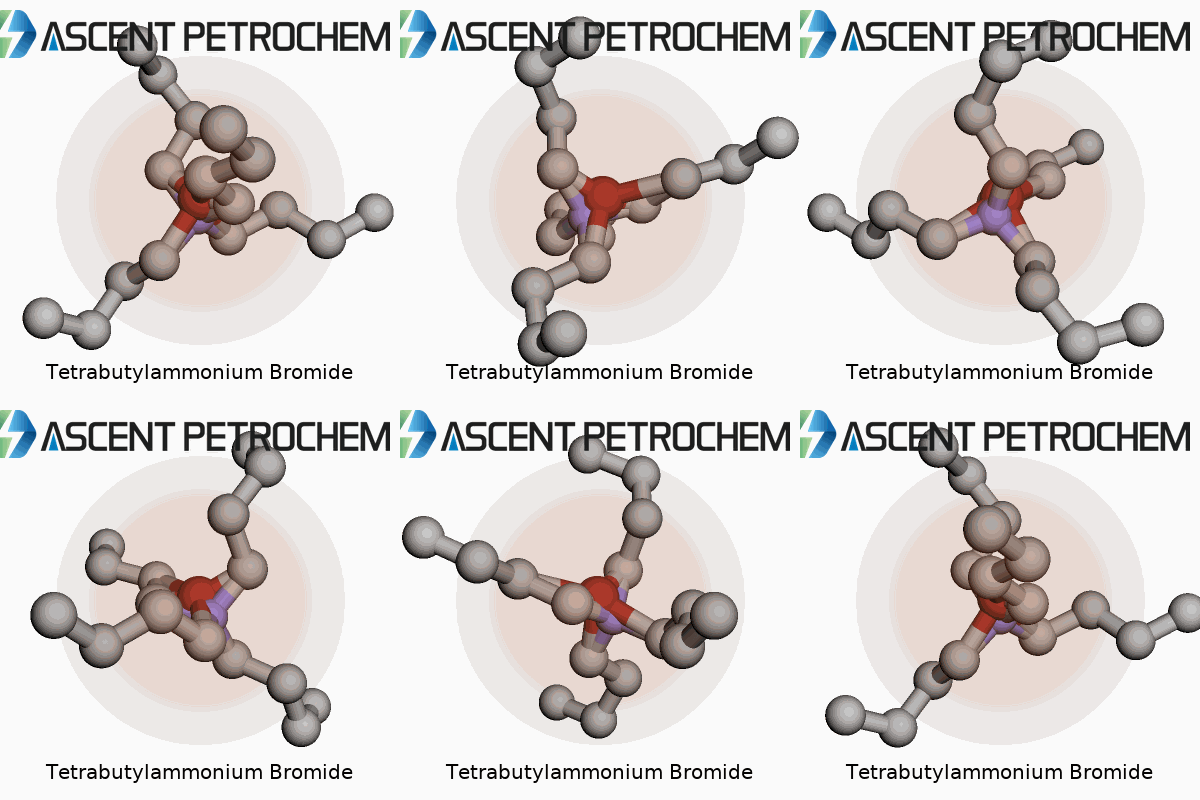
Mixing up chemicals in glassware, it’s easy to overlook why certain salts behave so differently. The big, bulky butyl chains wrap around the nitrogen, almost like a cushion, providing plenty of oil-loving character. This feature helps the compound slip between water and organic solvents. In certain synthesis steps, you might find water and oil refusing to mix. Here, tetrabutylammonium bromide steps in, helping materials in each layer interact. Yields improve, fewer harsh reagents go down the drain, and chemists save time fiddling over tricky separations.
Tetrabutylammonium bromide shows up in academic and industrial labs for one main reason: it gets stuff from one phase to another without much fuss. Think about organic reactions that normally crawl along at a snail’s pace, or ones that only work with exotic solvents. Add a bit of this salt, and you get more flexibility, routine reactions speed up, and stubborn ingredients finally cooperate. In electrochemistry, the same compound plays a role as a supporting electrolyte, keeping the ionic environment stable and predictable.
Handling any chemical, safety always makes the top of the list. Tetrabutylammonium bromide usually comes as a white, crystalline powder, and while it’s not wildly toxic, basic precautions matter. Laboratory gloves, goggles, and solid ventilation avoid mishaps no one wants to explain. Waste disposal deserves attention—never send residues down the drain without proper neutralization and approval from environmental staff. Manufacturers produce this salt on a scale that supports research and industry, so ensuring strict waste management helps keep labs and surrounding communities healthy.
Scientists always scout for milder, greener solutions. Some newer catalysts rely on bio-based materials or less persistent chemicals, decreasing environmental risks. Sharing best practices in waste reduction—for example, using just enough tetrabutylammonium bromide for a reaction without excess—prevents unnecessary buildup in lab waste. Teaching upcoming researchers careful weighing and solid housekeeping makes as much difference as choosing the right chemical for the job.
Learning chemical formulas like (C4H9)4NBr turns abstract textbook ideas into skills. Instructors who walk students through the logic—why each element sits where it does, how to draw the structure, and what each part does—set the foundation for careful science. Students grasp that chemistry isn’t just about rote memorization; it’s about combining precision and safety with curiosity, so they head into labs prepared for whatever comes next.
Tetrabutylammonium bromide—often called TBAB—shows up a lot in chemical research. It sits on many shelves in universities and R&D labs. TBAB acts mostly as a phase-transfer catalyst, helping reactions go smoothly where oil and water don’t like mixing. People who’ve studied chemistry have seen its white crystals and probably wondered just how safe it is to handle every day.
Anytime a chemical becomes common in the lab, people worry about its impact on health. The concern isn’t unfounded. If you spill TBAB on your skin, you might deal with irritation. Accidentally breathing in its powder also brings irritation to the nose, throat, or even your lungs. Swallowing it? Stomach upset and nausea usually follow. It’s not the sort of chemical you throw around without gloves or a mask just because it’s not as infamous as mercury or lead.
Looking at real data, TBAB doesn’t rank as a heavy hitter on acute toxicity lists, but that doesn’t free it from responsibility. Studies suggest moderate toxicity for aquatic life. In other words, dumping it willy-nilly down the drain causes genuine harm beyond the lab. Tougher regulations in Europe now monitor how much TBAB goes into wastewater, reflecting a larger trend where labs everywhere watch what they pour out.
Most chemists have faced a spill or two. Quick, careful cleaning with gloves and goggles makes a difference. I remember one frantic morning during my time in a student lab when the warning labels on a TBAB container got ignored. Dry, irritated hands went home with a classmate. Taking those risks lightly rarely works out. It’s odd how we sometimes let our guard down with substances that seem routine. Labels fade, warnings get shrugged off, and that’s when accidents find an opening.
Long before Google started rewarding expertise and authenticity, the best teachers in chemistry would drill into us to trust safety data. Now, with info everywhere and transparency being rewarded, that advice hits home harder. A 2021 review in the journal Chemical Research in Toxicology flagged not just TBAB’s properties but its growing footprint in industrial and academic settings. Continued growth in use means the risks pile up quietly if people get lazy with protocols.
Addressing potential hazards takes more than just lip service. In my own circles, folks have put up quick-reference cards near the TBAB bins. Training refreshers drive home the need to don gloves and keep the powder off bench tops. Keeping MSDS sheets updated and easy to grab helps everyone know where to look in a crunch. More senior lab-mates watch that disposal doesn’t cut corners. Substitution—where possible—with less harmful phase-transfer agents gives another layer of safety. Some recent studies point to alternatives based on greener chemistry, making the shift less disruptive than expected.
Tetrabutylammonium bromide doesn’t sit in the top tier of dangerous chemicals, but it demands respect and attention. Safe handling, mindful disposal, and open conversation about risks keep labs and the wider environment protected. Trust in a well-ventilated bench, good gloves, and clear information makes all the difference in the real world, away from polished product brochures and regulatory fine print.
Tetrabutylammonium bromide doesn’t sound dramatic, but this white powder quietly plays a key role in many chemistry labs. Used for phase-transfer catalysis, organic synthesis, and a grab bag of other reactions, it gets the job done through reliable chemistry. It’s nothing fancy—just a salt—but like many lab materials, it can turn into a headache with careless storage.
Open a container of Tetrabutylammonium bromide on a humid day, and over time you’ll find the powder starts to clump. The material draws water right out of the air, and those clumps? They mean more than a mess. Any absorbed moisture actually starts to change the compound’s mass and sometimes its reactivity. Relying on it for accurate measurements or sensitive reactions can become frustrating or downright risky.
The facts are clear: keeping it dry matters not just for chemistry purists, but anybody who values predictable results. The best approach sticks to what works—airtight bottles, preferably glass, with tight-sealing caps. Some take the extra step and store it alongside desiccants like silica gel packets. This practice may remind folks of saving jerky snacks, but lab chemicals actually benefit from that same low-tech approach.
There’s a temptation to keep every chemical in the coldest freezer or shove everything on the closest shelf. Tetrabutylammonium bromide doesn’t need to live in the freezer—it actually does just fine at room temperature. Refrigerators often end up humid, which defeats the purpose of trying to keep powders bone dry.
Direct sunlight also tips the balance toward trouble. Strong UV rays start to break down a surprising number of compounds. I’ve seen labels on plastic containers fade in weeks, and some powders yellow after a season left too long on a windowsill. Even though this one is fairly robust, it still makes sense to stick to tradition: keep the container in a cool, dry, and dark cabinet. These low-cost precautions add up over years, not just for this compound, but as great habits for anyone who spends time in the lab.
A reliable system for labeling bottles can save bigger troubles down the road. Permanent markers smudge; old tape peels. Anyone who’s spent a semester in student labs will remember at least one unfortunate incident with an unmarked bottle. Beyond the practicality, labeling details with chemical name, date of receipt, and hazard information ties right back to good lab safety and environmental management.
Tetrabutylammonium bromide isn’t especially toxic, but it doesn’t make sense to get careless. Gloves and eye protection should sit within reach. Accidental spills are rare but much easier to contain with good habits—like small containers, immediate clean-up, and a workspace free of clutter.
Good storage doesn’t hinge on expensive systems or high-tech gadgets. The smartest labs I’ve worked in always prioritized basic care: protection against moisture, sensible temperature control, storage away from sunlight, reliable labeling, and routine checks for clumping or discoloration. Tetrabutylammonium bromide rewards that attention, and so does every other chemical on the shelf.
There are chemicals you reach for because they make your life easier. Tetrabutylammonium bromide (TBAB) lands firmly in that category for most synthetic chemists. TBAB stands out thanks to its simple structure—a big, “greasy” ammonium ion paired with a bromide. You’ll find its bottle less dusty than others on lab shelves because chemists trust it to do some very practical jobs.
One of the biggest headaches in organic chemistry is mixing oil and water. Most organic compounds hate water, but a lot of useful reactions need both worlds to meet. TBAB acts like a chemical matchmaker, shuttling ions from the water phase over to the organic one. This process, known as phase-transfer catalysis, turns previously sluggish reactions into sprinters.
Take the classic alkylation of malonates or phenoxide ions—without TBAB, you waste time and solvent wrestling these reactions to the finish line. Drop some TBAB in, and the reaction moves along smoothly, often with better yields. Back in my grad school days, I watched students struggle before we switched to phase-transfer methods. Once TBAB entered the routine, people finished their projects instead of cursing in the fume hood.
Many classic classroom reactions, like the SN2 swap of a halide for a methyl group, need a good nucleophile and halide source. TBAB hands these over on a silver platter. Nucleophiles dissolve better when paired with TBAB, letting them react where they’d normally stand off awkwardly at the edges. This makes a huge difference if you’re working with stubborn starting materials.
Sustainability concerns drive a lot of chemists toward greener techniques. TBAB helps out by functioning as a building block for ionic liquids. These are salts that stay liquid at room temperature and often replace hazardous organic solvents. By swapping out volatile or toxic options for TBAB-based liquids, labs cut down dangerous emissions.
Researchers in pharmaceutical companies use TBAB-based systems to try out new transformations without falling back on classic but harmful solvents. This doesn’t just shrink the environmental footprint; it also protects people working with these chemicals every day.
TBAB’s usefulness keeps showing up in multi-step syntheses. For example, converting alcohols to alkyl bromides, or knocking a protecting group off a molecule, both benefit from a dose of TBAB. The bromide ion is ready to react, and the bulky ammonium helps keep things dissolved and mobile, pushing transformations toward completion. Medicinal chemists, making blocks for potential drugs, often rely on these tricks to turn complex starting materials into something new.
Seeing TBAB in action changes your opinion about how much the right additive matters. Its steady performance in phase-transfer reactions, nucleophilic substitutions, ionic liquid formation, and halogenations gives any synthesis campaign some extra speed and reliability. While not as flashy as some rare catalyst, this quaternary ammonium salt has earned a respected place on the lab bench—helping chemists solve real problems and keeping things moving forward.