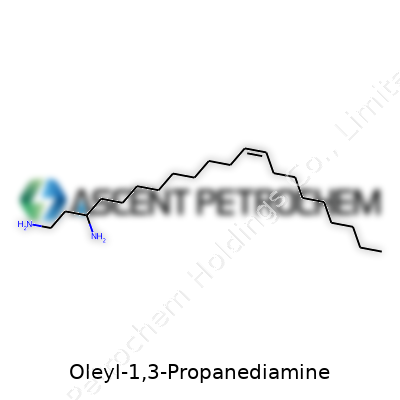
Back in the twentieth century, folks in the chemical industry looked for new amines to tackle tougher lubrication and emulsification problems. Oleyl-1,3-propanediamine came out of this wave of innovation. Its structure draws from unsaturated fatty amines, linking the flexibility of an oleyl chain with a simple propanediamine backbone. Unlike earlier amines, this molecule gave better performance for corrosion inhibitors in fuel additives and crop protection formulations. These advantages didn’t go unnoticed. Over the decades, its name and reach grew as companies looked for solutions that could do more than what traditional tallow-based amines ever managed.
At room temperature, you find the pure compound as a pale yellow, viscous liquid that sometimes seems almost waxy in the cold months. High boiling point means it does not just vaporize under moderate heat, which helps when mixing or formulating industrial products. The chemical formula shows two primary amine groups attached to a flexible propyl chain, while an 18-carbon unsaturated tail holds on the side. You notice a faint fishy odor—a common trait in aliphatic amines—making it easy to recognize even without sniffing devices. Solubility in water stays low, but it dissolves smoothly into most organic solvents—an edge for a formulator who blends components into complicated mixtures. The molecule, as you’d expect, has a molecular weight near 326 g/mol, and over time, this thing holds stable under regular storage conditions, without much risk of breakdown or foul-smelling side products showing up.
Labels on drums of this diamine often list chemical synonyms. You find names like N-(9-Octadecenyl)-1,3-propanediamine, 1,3-propanediamine, N-(9-octadecenyl), or just plain Oleylpropylenediamine. Some producers describe it through its CAS number 7173-62-8, an industry shortcut for ensuring everyone talks about the same molecule. Tech sheets spell out minimum purity—most suppliers promise over 90% active amine content—along with water and color indices drawn from standardized colorimetry scales. Acid and amine values show up because they reveal secondary impurities or leftover reagents from synthesis.
Manufacturers tend to rely on a condensation reaction between oleyl chloride and 1,3-diaminopropane. The process happens under controlled temperatures in stirred reactors, where each propanediamine molecule grabs an oleyl group through nucleophilic substitution. Sometimes, a solvent like toluene helps keep things flowing or to dissolve unreacted substrates later in the cleanup steps. Afterward, they wash the mix to neutralize leftover acids, then strip out water and solvent through vaporization. It sounds straightforward, but this process takes care and experience; skip the proper steps, and you wind up with unwanted dialkylated byproducts or gunk that won’t meet purity specs.
Chemists found lots of ways to modify this diamine. The double bond lets you attach extra additives—like epoxy or maleic anhydride—shifting solubility or reactivity without fully losing the amine’s punch. Companies quaternize it to make cationic surfactants; after methylation, these surfactants lend power to laundry detergents or hair conditioners. Epoxidation changes the reactivity too: instead of using it for simple emulsification, the molecule gets pressed into use as a polymer crosslinker for new plastics and adhesive resins that stick stronger or flex more. Neutralization with acids brings about salt forms, each offering distinct pH behaviors, a trick that shows up a lot in water treatment industries.
Oleyl-1,3-propanediamine comes with its own challenges in day-to-day operation. Safety sheets highlight its hazardous classification as a skin and eye irritant—even a little contact means red skin or watery eyes, and once breathed in, the vapors can make some people cough or wheeze. Chemical handling guidelines ask for chemical-resistant gloves, goggles, and use inside ventilated hoods. Storage tanks need rigorous labeling and containment to prevent leaks. Regulatory agencies, including OSHA and REACH, have stepped in with exposure limits and hazard labeling, helping prevent careless accidents and ensuring workers stay out of harm’s way. Spill procedures call for immediate containment and neutralization with weak acids, ensuring that the compound does not wind up in storm drains where it could harm aquatic life.
In fuel additives, Oleyl-1,3-propanediamine earns respect as a corrosion inhibitor—helping pipelines and storage tanks last longer, even under harsh, wet conditions. Crop protection companies blend this diamine into herbicide sprays to improve leaf penetration and spreading. Textile folks add it to softener blends, giving finished fabrics a gentler hand feel and anti-static qualities not possible with basic fatty amines. Water treatment engineers rely on its solubilizing action to remove scale and biofilms in cooling towers. In manufacturing, plastic additives and epoxy modifiers made from this backbone raise impact resistance and aging properties, opening up more flexible packaging and coating solutions.
Chemists in academic and industrial labs continue pushing this molecule in new directions, searching for greener production pathways, lower toxic emissions, or even renewable feedstocks as alternatives to traditional oleyl sources. Recent journals report enzymatic and bio-catalyzed production attempts, hoping to skip harsh chemicals. Simulation studies use molecular modeling to tweak surfactancy, helping products perform better at lower concentrations. Other groups dig into quaternized forms, testing antimicrobial coatings against stubborn hospital microbes or creating specialty antistatic floor treatments. Every new application brings questions—can we keep performance high without raising regulatory barriers, or do we need to rethink starting raw materials for a future with stricter sustainability rules?
Toxicity researchers highlight the potential hazards of Oleyl-1,3-propanediamine: undiluted liquid has shown moderate toxicity in animal studies, causing skin and airway inflammation at high dosages. Aquatic toxicity results show it can harm fish and invertebrates even at low concentrations. Biodegradability testing suggests that—like many long-chain fatty amines—the molecule degrades slowly in the environment, raising red flags for persistent pollution near manufacturing sites. These realities push regulators and users to demand closed handling systems, rigorous wastewater treatments, and alternatives where possible. Companies investing in toxicology research recognize transparency: updating hazard classifications and communicating risk help foster trust with communities, customers, and downstream users.
Oleyl-1,3-propanediamine faces a crossroad: demand for high-performance surfactants and corrosion inhibitors stays steady, but pressure from environmental advocates and stricter regulations grows every year. Forward-thinking suppliers explore plant-based feedstocks, or they search for nature-inspired molecular tweaks that speed up biodegradation. Industry panels bring together toxicologists, environmental scientists, and manufacturers to share findings, spot risks before they hit headlines, and swap ideas on safer, renewable alternatives. The next decade won’t look the same as the last; the best-used amines will combine proven performance, clear safety data, and production that stands up to public and regulatory scrutiny. Getting there takes smart chemistry, open communication, and a willingness to update old routines to fit new realities — something this field has tackled before, and will surely do again.
Oleyl-1,3-Propanediamine pops up in places most people don’t notice. In my years watching industrial chemistry move from one breakthrough to another, I’ve seen how a compound like this makes its mark far outside of textbooks. Take wastewater treatment. Plants rely on chemicals that stick to tiny particles, so workers can yank out contaminants. This amine steps in as a coagulant, helping gather up the stuff we want out of our water. Without such molecules, companies spend much more time and money chasing clean water. People underestimate the impact of small improvements in treatment chemicals on both cost and final water quality. I’ve seen facilities lower operating expenses just by switching the formulation of their water cleaners—and Oleyl-1,3-Propanediamine often drives those upgrades.
Cleaning products use it, too. The dual amine group in the molecule helps it grab grease and keep it off surfaces. Think of how dish soap promises to cut through stubborn pans—that effective cleaning relies on surfactants, and this one offers strong performance. You’ll find it on ingredient lists for industrial degreasers, hard-surface cleaners, and even some laundry detergents. I’ve tried formulations with and without amine-based surfactants, and the difference in residue left behind tells the story: amines like Oleyl-1,3-Propanediamine do more than pull dirt off, they keep it suspended long enough to rinse away.
Factories can’t afford static shocks. They build up on conveyor belts, cables, plastic sheeting, and one zap can ruin electronics or even ignite flammable fumes. Oleyl-1,3-Propanediamine finds work as an antistatic agent because it coats surfaces with a layer that breaks up charge. In the packaging business, this property keeps plastic bags and wraps from sticking together. I’ve had engineers tell me they noticed longer equipment lifespan and fewer malfunctions after adjusting antistatic agents in their process. Even if it seems like a small fix, it changes daily operations.
In machinery, metals grind and fluids that reduce wear matter. This amine serves as a lubricant additive, sticking to metal and creating a slippery shield between moving parts. My time in automotive repair taught me how a thin film of the right lubricant stops parts from seizing, limits downtime, and keeps engines quieter. In marine and pipeline sectors, Oleyl-1,3-Propanediamine also acts as a corrosion inhibitor. Saltwater eats through steel, and without protection, repair work can dominate budgets. Field reports show noticeable differences in how long equipment lasts when the right additives are in place.
Any industrial chemical brings safety needs. This amine can irritate the skin and eyes, so anyone working with it should wear solid protective gear. I’ve seen operators ignore a new label and pay for it with rashes. Companies benefit from in-house training sessions and clear material handling rules. There’s growing focus on finding lower-toxicity options and improving wastewater management. The industry could invest more in green chemistry studies, aiming for surfactants and additives with less environmental baggage. Some groups track the downstream impact of amines on rivers and soil, giving buyers more information to choose safer products.
No single chemical holds all the answers, but Oleyl-1,3-Propanediamine shows how specialty ingredients play practical roles in clean water, safe factories, and better machinery performance. As research pushes forward, workers and consumers have more tools for clean, safe, and efficient operations.
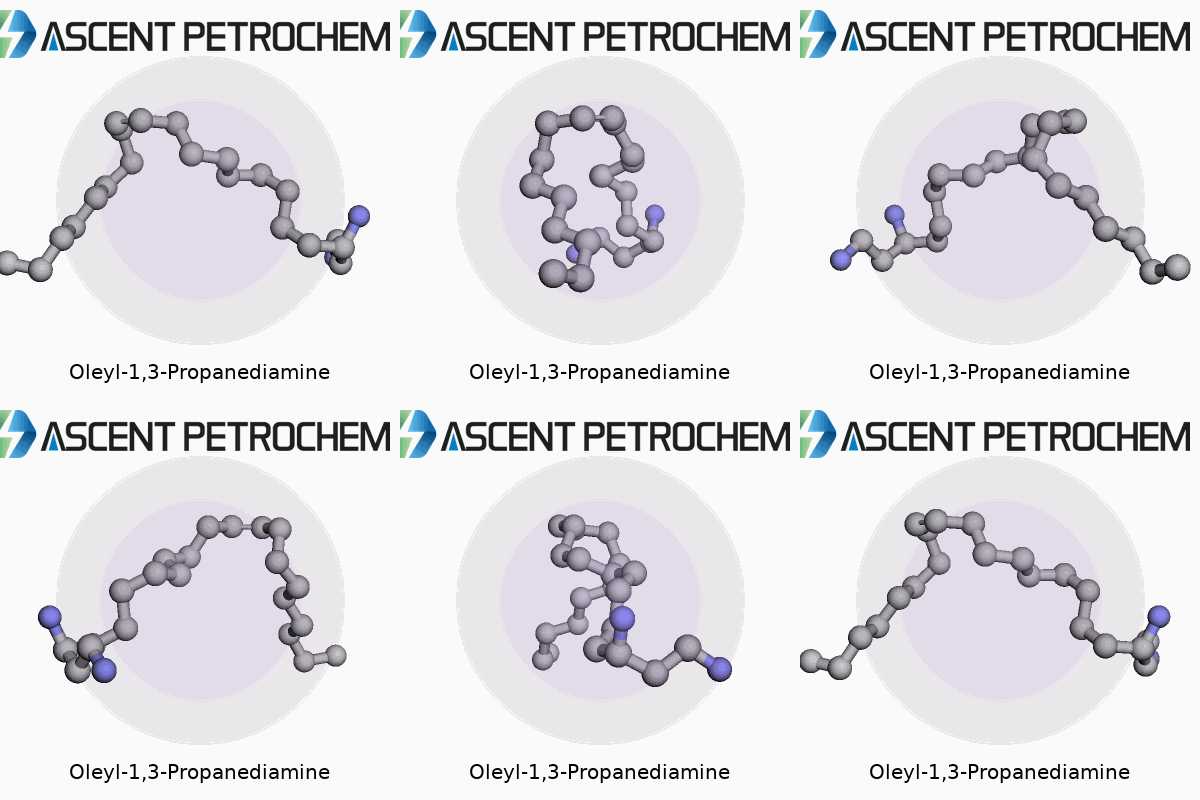
Oleyl-1,3-propanediamine stands out in industrial chemistry because of its unique molecular build. Structurally, it brings together a long-chain unsaturated fatty amine (the oleyl group) with a propane-based diamine. Its chemical formula, C21H44N2, tells us it houses 21 carbon atoms, 44 hydrogens, and two nitrogens. The heart of the molecule features a backbone with eighteen connected carbon atoms, one double bond (typically in the cis-9 position, akin to the natural oleyl group from oleic acid), capped with a propanediamine group at one end.
The defining motif in this molecule is its combination: an oleyl tail hooks onto a propane core, which itself is flanked by two amine (NH2) groups. The result? One end of the molecule is drawn out like other fatty molecules, hydrophobic and slick. The other is hydrophilic, friendly to water-based partners, because of the two reactive amine ends. Chemists reading this may remember how critical these polar ends get both in synthesis and in end-use as surfactants or in fabric softeners.
This split personality—one oily, one basic and water-friendly—unlocks a heap of uses. Working with textile softeners earlier in my career, I found molecules like this excel at breaking surface tension. Their tail slips between fibers, and their head latches to water or ionic stuff. In water treatment or cleaning agents, the dual affinity lets these molecules dissolve oils that would annoyingly cling to machinery or pipes.
Particular focus often lands on the amine groups. They tend to grab on to acidic species or form bonds with metals, making them practical in corrosion inhibition or as intermediates when producing specialty chemicals. With rising demand for greener and more effective chemicals, the structure of oleyl-1,3-propanediamine plays a major role in improving not just the performance, but the safety profile and biodegradability of finished products.
Treating oleyl-1,3-propanediamine seriously matters due to exposure risks. As with many amines, this compound causes skin and eye irritation. Repeated, careless contact leads to allergic reactions. Responsible handling, including gloves and eye protection, needs to be standard. Based on animal studies in published safety sheets, ingestion or inhalation brings risk, so clear storage and careful dosing become a must at any busy chemical blending plant.
The environmental side asks for vigilance. Industrial spills of long-chain amines quickly harm aquatic life. Thanks to the molecule’s design, it accumulates in organisms and resists quick breakdown in water. Responsible disposal—through licensed waste management and treating any effluent before returning it to waterways—must stay a top priority. There's a real push in production to move toward less persistent amines and to seek breakdown-friendly alternatives, even if they come with a cost premium up front.
Real progress has grown from partnerships between chemical firms and environmental scientists. Designing molecules with built-in "cleavage" points, for automatic breakdown in the environment, offers a future worth watching. More manufacturers lean on bio-based or recycled feedstocks, reducing the impact right from raw material sourcing. Communicating with regulators and customers—demonstrating clear safety data and life-cycle analysis—builds trust, not just compliance.
Oleyl-1,3-propanediamine shows how clear, smart design can shape entire industries, create effective products, and challenge chemists to think beyond the reaction flask to wider planetary effects.
Oleyl-1,3-propanediamine pops up in plenty of industrial processes. Its main role often lands in cleaning products, oilfields, and as a surfactant in other manufacturing work. If you handle industrial chemicals, chances are you’ve read a Material Safety Data Sheet or two, wading through unfamiliar chemical names and health warnings. Oleyl-1,3-propanediamine tends to sneak under most folks’ radar, but there’s no skipping due diligence when safety is at stake.
Using this compound without proper gloves, goggles, or protection, the hazards become real. Skin and eye contact raise red flags. Studies and workplace experience show that even limited exposure can cause skin irritation, itching, or even burns for some. Getting it in your eyes? That can mean redness, watering, and plenty of discomfort—sometimes worse. Breathing in its vapors, especially in tight, unventilated spots, can trigger breathing trouble or throat irritation. The risk isn’t just on paper—across factories, incorrect handling has sent people to the medic more than once.
This kind of chemical doesn’t just stay put after use. If it leaks into local water systems, evidence points to real harm for aquatic life. Fish, amphibians, and the critters at the bottom of lakes and streams struggle to survive with certain concentrations. Studies on toxicity show that Oleyl-1,3-propanediamine acts as a pollutant, causing tissue damage or death in sensitive species. Communities downstream know the cost when a company cuts corners—news headlines tell story after story.
No mystery why most countries, including the US and those in the EU, require detailed labeling and set limits for workplace exposure. Laws shape how manufacturing, transporting, and disposing takes place. Anytime companies ignore the rules, everybody loses. There’s also the question of chronic exposure—a slow, long-term problem that can slip right past most health checks, showing up after years of low-level contact. Workers often know their own bodies better than a short checklist does.
Protection isn’t a distant ideal; it’s gloves, goggles, and air filters, ready before any handling or mixing starts. Supervisors and safety trainers benefit from digging into the incident reports—learning from real mistakes. Environmental agencies recommend keeping tight records, double-checking storage conditions, and preparing spill kits. In smaller shops or plants, setting aside five minutes for real talk—not just a rushed safety briefing—often saves injury and cuts cleanup costs.
Science hasn’t stood still. Researchers keep looking for alternatives with fewer risks for both people and the environment. Some companies have switched to other surfactants that break down more easily or show less toxicity to fish and plants. But switching takes investment and time. Until then, it comes down to knowing what you’re working with, following agreed steps, and respecting what happens when chemistry goes outside the lab or plant.
Oleyl-1,3-propanediamine won’t disappear from industry anytime soon, but every year brings newer tech, better habits, and smarter safety culture. Lives have improved because people stayed curious, looked at the facts, and pushed for change instead of accepting routine hazards as the price of progress.
Oleyl-1,3-propanediamine plays a subtle but key role in a range of industrial products. Think of it in corrosion inhibitors, lubricants, surfactants for cleaning products, and a smart helper in a variety of chemical processes. Working with this amine in the real world is a different story than ticking off requirements from a material safety data sheet.
Oleyl-1,3-propanediamine does not cope well with moisture or a careless approach. Exposing the original drum to damp air can wreak havoc, leading to unwanted chemical changes and affecting how it performs in formulations. In our lab, the smell is a giveaway—moisture contamination sends this faint, fishy amine odor right through the air, and that spells trouble for purity.
Dry, cool, and well-ventilated spaces favor this compound. Think 15°C to 25°C, away from sunlight and away from anything that might spark or cause intense heat. Oleyl-1,3-propanediamine drips, seeps, and clings to surfaces if you’re messy. I’ve seen sticky tools and half-closed drums that turned a simple storage room into a slippery hazard zone. Leaving it in open containers creates condensation in no time, especially in humid climates, which doesn't just ruin the product—it puts workers at risk of slips and exposure.
This compound hurts skin and eyes, and breathing in vapors causes discomfort. Gloves and splash goggles keep you safe, but the simple habit of sealing every container with a fresh, dry lid keeps accidents and waste low. Ventilated storage doesn’t just control fumes—it cuts down on odors that travel far and wide. Open storage or poor ventilation means the whole shop or warehouse picks up that chemical scent fast, and as someone who’s worked in shared spaces, no one wants that on their clothes.
Labeling matters more than many admit. Two similar drums with faded markings led to a costly mix-up on a job I remember. Use clear, chemical-resistant labels and put the handling protocol right next to the drum. This saves confusion and keeps even well-trained staff from skipping safety routines.
Oleyl-1,3-propanediamine isn’t the best friend of oxidizers or acids; these can trigger dangerous reactions. Spills and leaks in my past workplaces usually came down to people topping up containers past their safe levels, or stacking drums two high on unstable pallets. Using spill trays and not trusting the original packaging beyond a year or two “in the wild” keeps floors cleaner and assets protected.
Disposal weighs on my mind, because pouring leftovers down the drain isn’t an option. In local regulations from the US EPA and the EU, improper disposal draws fines and environmental warnings. We sealed spent containers, arranged for certified hazardous waste pickup, and double-checked that every last drop got handled right—not just tossed. That’s how you keep headaches and liability at bay.
Weekly audits revealed forgotten containers or signs of leaks in even the tidiest storerooms. Practicing regular inventory reviews, using absorbent pads under drum taps, and giving new staff a walk-through before they handle the product all help trim down risk. Suppliers often offer fresher stock if you ask, and in critical projects, using recently produced material reduces surprises.
Oleyl-1,3-propanediamine rewards that kind of steady, real care. Safety isn’t just protocol—it's keeping everyone calm, minimizing waste, and making sure a day’s production ends without stories of spills or sick staff. Real life gets easier if you treat this compound with the careful respect it deserves.
I’ve watched plenty of chemicals come and go in different roles, but Oleyl-1,3-Propanediamine keeps popping up in places most people overlook. This molecule may not sound familiar in daily conversation, but if you walk into almost any facility where surfactants show up in products, chances are, this amine has played a part behind the scenes.
Factories that churn out cleaning agents use Oleyl-1,3-Propanediamine because it helps dirt break free and washes away more easily. Production lines for detergents and specialty cleaners count on it to control foam levels or boost the cleaning power. Experience in chemical supply taught me that companies want mixtures that rinse off quickly without leaving a sticky film. This diamine shows up right in the recipe, doing its job to keep surfaces sparkling—and safe—from the build-up of grime and oily residues.
The oil and gas sector continues to call for specialty amines. Oleyl-1,3-Propanediamine plays a solid role treating pipelines and drilling equipment. You’ll find it in the blend for corrosion inhibitors, where the chemical latches onto metal surfaces, protecting costly infrastructure. Pipelines must last decades through tough weather, water, and chemicals in crude. This amine works as a behind-the-scenes defense against corrosion, preventing major safety risks and saving energy companies money in the long run. Data from the American Petroleum Institute indicates corrosion costs the industry over $15 billion yearly. Using ingredients like this diamine slows that drain on resources.
The textile industry has shifted a lot as consumers ask for softer, more comfortable fabrics with cleaner production methods. Oleyl-1,3-Propanediamine finds work in processing cotton and synthetic fibers. Mills use it to soften cloth and help dyes stick evenly to threads. If you like t-shirts that stay soft after lots of washes, there’s a strong chance this molecule helped. Environmental pressures have forced firms to swap out rougher chemicals for gentler ones, and plant-based surfactants like this oleyl compound step into those shoes easily.
Farmers face tight margins and heavy regulations, so crop protection products must deliver results without hurting fields or food quality. Oleyl-1,3-Propanediamine often appears in herbicide and pesticide recipes as an adjuvant. It helps sprays spread smoothly over leaves and lets the active ingredients stick around long enough to do the job. The right mix means dry fields get coverage in one go, using less water and cutting potential runoff, a point no farm operator takes lightly. Reports from the Food and Agriculture Organization about water-saving measures in agriculture underline why smarter surfactants matter for food supplies everywhere.
I’ve learned that knowing your inputs pays off. Regulations on handling amines grow stricter, and calls for greener chemistry keep rising. Workers need solid training, and companies have to reduce exposure where possible. Encouraging wider research into plant-derived alternatives or recyclable blends could shrink the health and pollution risks in busy factories. Industry collaborations and transparent labeling help all of us understand exactly what ends up in water, air, and soil. Every time a business tweaks its process for health or safety, folks downstream in the community benefit, too.