Chemists started paying attention to aliphatic amines as building blocks for organic synthesis a long time ago, but N-Octyl Amine’s own story runs parallel to the mid-20th century boom in petrochemical industries. As researchers explored longer-chain amines, they saw the potential for N-Octyl Amine in surfactants, pharmaceuticals, and specialty chemical production. Looking back, early literature in Germany and the United States documented its first preparations from octyl halides and ammonia, making it clear that this amine came about during a broader search for practical and scalable organonitrogen reagents. Laboratories seeking cost-effective, straight-chain alkyl amines found N-Octyl Amine attractive because its production didn’t involve complex catalytic steps common to branched or aromatic relatives.
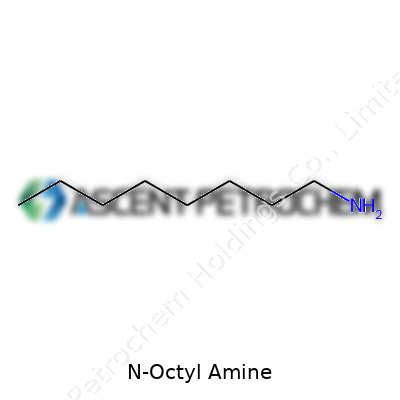
N-Octyl Amine—also recognized as 1-octanamine or Aminooctane—offers an eight-carbon straight alkyl chain attached to an amino group. It’s colorless to pale yellow with a distinct fishy odor. Commercial suppliers deliver it as a liquid, targeting customers in pharmaceuticals, agrochemicals, dye intermediates, corrosion inhibitors, fuel additives, and surfactant manufacture. Because of its molecular structure, it behaves as both a fairly strong organic base and a nonpolar hydrocarbon tail. This unique combination lets it dissolve both in common organic solvents and partially in water, where its hydrophobicity starts to show.
N-Octyl Amine’s structure brings together hydrophilic and lipophilic characters. It has a boiling point near 179–182 °C and a melting point close to −12 °C. Its flash point sits well above room temperature, but the compound needs careful handling above 60 °C. Density runs roughly 0.78–0.81 g/cm³ at 20 °C, which means it floats on water. The amine group allows for hydrogen bonding, supporting some solubility in water, though its long alkyl chain limits this compared to shorter-chain amines like ethyl- or propylamine. Chemically, it reacts with acids to form salts, serves as a nucleophile in alkylations, and is sensitive to oxidation. In the lab, it behaves predictably with reagents like acyl chlorides, aldehydes, and isocyanates, making it a convenient starting material for more elaborate molecules.
Suppliers sell N-Octyl Amine at various purity levels, most often above 98%. Specifications cover refractive index, color standards (APHA), moisture content (using Karl Fischer titration), and GC impurity profiles. Materials come with printed safety symbols highlighting its toxicity, flammability, and need for eye and skin protection. Shipping documents follow global standards, such as IATA and IMDG, for chemical transport. Storage needs revolve around temperature control and keeping it away from oxidants and strong acids, as storage in plain steel drums might cause contamination or unwanted reactions. Labels typically use the IUPAC name, CAS number (111-86-4), and vital hazard pictograms.
The classic synthesis of N-Octyl Amine runs through nucleophilic substitution. Octyl halide—usually prepared from 1-octanol—is treated with ammonia, often under pressure. This step yields a mixture of primary, secondary, and tertiary amines, with N-Octyl Amine extracted and purified through distillation. Some manufacturers choose reductive amination, where octanal reacts with ammonia in the presence of hydrogen and a metal catalyst like nickel. This approach gives better selectivity and environmental footprint, skipping halogenated intermediates and minimizing waste. These days, green chemistry advocates prefer this catalyzed route for industrial-scale production.
N-Octyl Amine reacts readily with carboxylic acids to make amides, a transformation valuable in pharmaceutical and surfactant design. Exposing the compound to acyl chlorides brings efficient conversion to N-octyl amides. In presence of nitrous acid, it can give rise to alcohols through diazotization, though yields trail those found with aromatic amines. Alkylation with alkyl halides creates secondary and tertiary amines, common in specialty surfactants and corrosion inhibitors. Chemists value its reactivity with isocyanates to form ureas and with aldehydes or ketones to form imines, key steps in many multistep syntheses. Moreover, hydrogenation and oxidation can tailor the amine for even more precise applications, whether quaternizing for surfactant production or oxidizing to generate amides for polymer use.
Across different industries and supplier catalogs, N-Octyl Amine turns up under plenty of names: 1-octanamine, octylamine, Aminooctane, n-Octan-1-amine, Caprylamine, and Uniline 78. Regulatory documents prefer the IUPAC name or the clear “N-Octyl Amine” for workplace safety sheets. Some trade names, especially in coatings or industrial cleaners, tweak the spelling or branding to suit corporate identity, but the chemical itself remains unchanged.
Handling N-Octyl Amine poses risks familiar to chemical operators. Its vapors irritate mucous membranes, and direct contact burns skin and eyes. Chronic exposure may act as a sensitizer or affect the nervous system. OSHA and REACH guidelines require gloves, goggles, and chemical-resistant aprons for workers. Ventilation becomes essential because even low vapor concentrations can cause headaches or respiratory issues. Storage should avoid strong oxidants or acids. Emergency showers and eyewash stations stay close to work areas. Fire safety rules treat it as a flammable liquid, demanding grounding, secure containers, and no open flames or hot surfaces nearby. Supervisors train staff to recognize early symptoms of exposure and manage accidental spills with absorbents meant for amines. Proper waste handling avoids disposal in drains to stop aquatic harm, as regulations demand incineration or licensed hazardous waste processing.
N-Octyl Amine goes into a surprising range of finished products. Surfactant producers blend it into cationic or amphoteric agents that show up in both shampoos and fabric softeners. Chemical engineers develop corrosion inhibitors for pipelines and boilers with this amine as a backbone, due to its affinity for metal surfaces and straightforward formulation. In agrochemicals, it pops up as a precursor for herbicide and fungicide actives, bringing both lipophilicity and surface-wetting characteristics. Dye manufacturers use it to make intermediates that fix colors to textile fibers. Some pharmaceutical syntheses count on N-Octyl Amine for amide bond formation or as an intermediate for anti-inflammatory drugs. The electronics sector finds use for it in photoresist developers and specialty solvents, while oilfield applications rely on its dispersant action and nitrogen content for chemical treatments.
Academic and corporate labs constantly look for ways to tame or harness the reactivity of N-Octyl Amine in new settings. Scientists working on “green” solvents investigate derivatization to produce task-specific ionic liquids. Nanotechnology studies want to explore attachment methods for functionalized surfaces. Polymer chemists try incorporating N-Octyl Amine groups to modify chain mobility and film properties. Biosciences research digs into using labeled versions as probes to map enzyme activity or track amino-functionalization in proteins. These efforts keep the compound relevant long after its original applications matured, as chemists tweak procedures for sustainability, waste reduction, and fine-tuning performance.
Toxicologists highlight that while acute oral and dermal LD50 figures for N-Octyl Amine suggest moderate toxicity, repeated exposure matters for long-term health. Inhalation studies on rodents show some evidence of neurological impact, though most cases involve much higher concentrations than found in workplaces. Regulators flag it as a respiratory and skin irritant, especially for those with existing allergies or asthma. Contamination of water sources causes direct harm to aquatic organisms, with sublethal effects noted in fish and daphnia at parts-per-million levels. Ongoing studies target its biodegradation rates—a key factor in environmental risk. Labs aim to engineer amine derivatives with lower eco-toxicity or design safe disposal and remediation strategies for spills.
Researchers and manufacturers expect demand for N-Octyl Amine to remain steady as markets push for higher-performance surfactants, specialty coatings, and next-generation pharmaceuticals. Green chemistry initiatives drive work toward less energy-intensive production routes and safer derivatives. One path centers on bio-based syntheses, where enzymatic or fermentation approaches could yield “drop-in” N-Octyl Amine from renewable feedstocks, sidestepping petrochemical steps. Others focus on closing the loop with full recycling of amine wastes. Computational chemists model toxicity and reactivity to screen more potent and less hazardous derivatives before real-world testing. As regulatory pressure and expectations on environmental safety mount, companies keep adapting how they make, use, and dispose of N-Octyl Amine—balancing its established utility with society’s call for safer and greener chemicals.
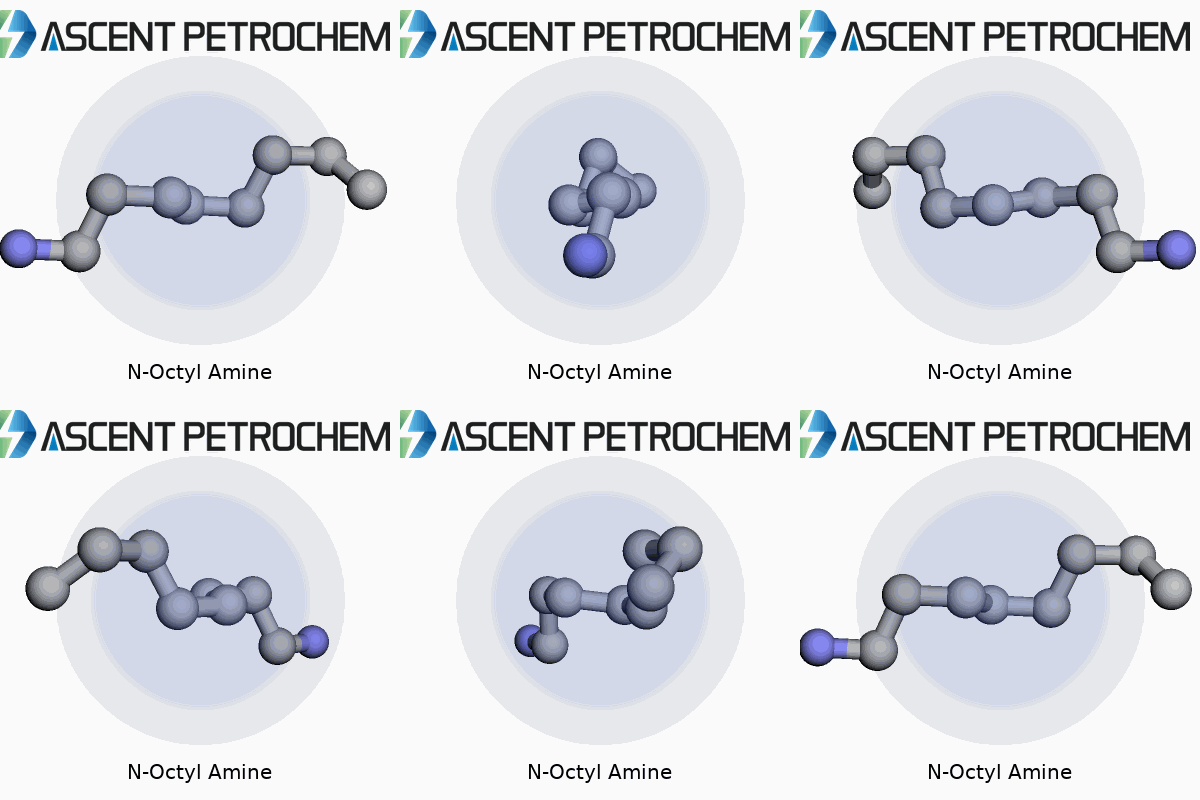
N-Octyl amine carries the formula C8H19N. This tells a pretty clear story. There are eight carbon atoms holding together a chain, nineteen hydrogens latching onto the backbone, and one nitrogen. That nitrogen atom is where the “amine” part comes from. The carbon chain—octyl—counts out eight carbons, all stacked in a straight line, which is important for how this molecule behaves and fits into real-world uses.
The application of N-octyl amine stretches from chemistry labs to big industry. Many may only notice its scent—a strong, ammonia-like punch—but experts see a versatile starting point. As an amine, it helps build more complex molecules. Factories turn to it when making things like surfactants, corrosion inhibitors, and even rubber processing chemicals.
Though it may not draw much attention, handling any chemical calls for respect. Strong odors often serve as a safety signal, and N-octyl amine fits the bill. Exposure can lead to respiratory irritation or skin discomfort, making protective habits necessary. A splash on your skin stings; a whiff too close can irritate the nose and throat. Safety data shows that both acute and chronic exposure bring risks, ranging from burns to more subtle long-term health changes if not managed.
Even routine chemistry impacts wider life. N-octyl amine marks just one spot in the chain of carbon-based chemicals put to use every day. Its relatives can spill into rivers or drift into the air, leaving an environmental footprint. For instance, improper disposal could threaten water ecosystems. Some amines break down fast, but others linger, and regulators look closely at these trails.
It’s easy to lose sight of humanity behind a chemical formula, but I’ve seen how poor practices, even with small amines, multiply into headaches down the road. A well-run lab or plant builds procedures that keep chemicals contained—from vent hoods to smart storage and disposal. Staff training and quick access to proper safety gear help everyone stay in one piece. Experience brings comfort, but complacency never belongs where chemicals come out of the drum.
Reducing the risks tied to N-octyl amine takes more than checklists. Substitution, ventilation, and education all play a part. Swapping to less volatile or less toxic amines can work for some applications, but it requires real research and testing. Proper labeling and locked cabinets prevent wandering hands or accidental mixing. Continuous monitoring—think sensors that warn about leaks—adds a safety net that technology has finally made practical for more than just the largest facilities.
On the regulatory side, organizations like OSHA and the EPA keep updated guidelines. They do not only protect workers but also keep downstream communities safe. Embracing those guidelines instead of seeing them as hoops to jump through shifts workplace culture toward prevention. Good chemistry benefits everyone, and every vial or drum of N-octyl amine handled with care creates a safer world for those in the lab and out.
N-Octyl Amine doesn’t usually make headlines, but a lot of products across multiple industries start with it. In my years writing about chemicals in manufacturing and agriculture, I’ve seen it crop up everywhere from water treatment plants to the back rooms of large cosmetics labs. I learned that workers in textile factories depended on its properties just as much as pharmaceutical giants designing new medicines. So, what makes this chemical a regular guest behind the scenes?
In water treatment, N-Octyl Amine helps keep rivers safe by removing unwanted metal ions. I’ve spoken to operators at municipal plants who rely on it to clean up everything from drinking supplies to local wastewater. Its surface-active properties help grab onto impurities and pull them out. It's the same story in mining, where it’s mixed into mineral flotation tanks. The mining staff told me that, without surfactants like this, they would struggle to get pure product out of raw ore. Think of copper mining, where amines separate valuable minerals from regular rock—the line workers appreciate any tool that keeps the process cleaner and more efficient, which cuts down on waste and costs.
Drop into a pharmaceutical R&D lab, and you’ll see N-Octyl Amine among long rows of bottles. Researchers build complex molecules for medicines on top of simple amines like this one. It acts as a building block for active ingredients in antihistamines and anesthetics, making these drugs faster and cheaper to produce. Because it’s stable, it lets scientists test new synthetic pathways, opening up more options in fighting rapid mutations or rare diseases. Here, safety matters a lot—N-Octyl Amine gives chemists flexibility without forcing them to compromise on purity.
A lot of folks don’t think about the chemicals behind their favorite cleaning spray or shampoo. N-Octyl Amine finds its way into these products because it helps with emulsification—blending oil and water, so you get a consistent product. Personal care brands use it in lotions and hair conditioners because it smooths the product, both on your skin and inside the bottle. On top of that, it acts as a corrosion inhibitor in the lubricants found inside machinery or car engines. From my own time working with mechanics, I remember how they paid close attention to corrosion after winter, when road salt eats away at exposed metals. Using an amine surfactant prolongs the life of equipment.
Farmers are always working to balance crop yield with environmental care. N-Octyl Amine steps in as a raw material for herbicides, pesticides, and growth stimulants. Scientists at agrochemical firms count on it to create new compounds that break down in the soil once their work is done. More targeted application means less chemical runoff—something food producers and environmental groups both want to see. The push toward green chemistry creates real pressure for manufacturers to use intermediates like this instead of older, heavier legacy chemicals.
Sourcing and handling matter—a quick tour of any chemical warehouse makes that clear. Producers now look for suppliers who minimize impurities and offer cleaner synthesis methods. Responsible storage limits occupational risks, which is something regulators pay closer attention to year after year. Training for safe handling and regular audits help keep workplaces and end users safe. As technology evolves, more companies could discover even more efficient ways to use this amine for industrial and consumer applications.
N-Octyl Amine finds its way into a range of industries, from chemicals to personal care. Anyone working around this compound knows it brings hazards: it's a skin and eye irritant, and the fumes can sting the lungs and nose. Plenty of folks shrug off these risks, trusting a pair of gloves or a fume hood. But accidents rarely give a warning before making someone regret cutting corners. I’ve seen folks rush a step or grab the wrong gloves, only to deal with a nasty rash or a cough that lingers. This stuff doesn’t just wash off like soap.
Personal protective equipment (PPE) isn’t just for lab inspectors or factory tours—it’s a daily line of defense. Splash-proof goggles, chemical-resistant gloves, and a sturdy lab coat become everyday armor, not just a formality. It’s easy to fall into the trap of thinking short tasks don’t deserve full gear. In my time coaching new hires, the ones who skipped PPE just once were the ones filing incident reports. Make eye protection and gloves a habit every single time, not just for show.
N-Octyl Amine isn’t shy about sending up vapors. Open windows won’t cut it in a lab or plant setup. Local exhaust, fume hoods, or designated ventilated spaces pull contaminated air away, giving lungs some backup. Relying on scented candles or regular fans gives a false sense of security. The right ventilation not only clears the air, but it keeps exposure levels low during regular use and those times someone accidentally spills a bit more than planned.
Strong odors cling to open bottles, and a knocked-over container spreads more than just a smell. Using tight-sealing lids and chemical storage cabinets built for amines makes a difference. I’ve watched someone store N-Octyl Amine in a break-room fridge once; it took days to air that smell out, and a call to poison control followed. Chemicals demand respect, not shortcuts. Every bottle gets a clear label, and incompatible chemicals—like acids or oxidizers—stay far apart.
No matter how careful a person tries to be, spills happen. There’s real peace of mind in knowing where the nearest eyewash station lives and making sure it works before it matters. Keep absorbent materials handy for small spills, and train every team member on what to do if something larger soaks through gloves or clothes. I once saw a minor splash dealt with by washing up right away, while a slower response at another site led someone to a clinic with a chemical burn. Quick action matters.
Written procedures and safety data sheets don’t mean much on their own. It’s the repeated practice and reminders that stick. Talking through real-life scenarios, walking new folks through cleanup routines, and nudging experienced hands to brush up on best ways to handle emergencies makes a noticeable impact. I remember a stubborn old timer scoffing at drills, then leading the charge during an unexpected fume leak later that year. Everyone has something to learn and something to teach.
It’s not just about boxes checked on a form or posters tacked on a corkboard. Sharing stories, showing proper technique, and speaking up when a step gets skipped sets a standard. N-Octyl Amine reminds us, every day, that the simple routines—gearing up, labeling right, checking gear—aren’t fussy, they’re smart. It only takes one mistake to prove that point, and I hope fewer folks find out the hard way.
N-Octyl amine stands out in the world of specialty chemicals because even a small impurity can mess with how it acts in industrial or lab settings. The purity specification for commercial N-octyl amine generally sits at 98% or higher. That number isn’t just a badge of honor for the supplier—it marks the difference between a batch that runs smoothly and one that causes headaches down the line.
I remember working in a manufacturing setup where a surfactant project hit a wall. The problem traced back to N-octyl amine sourced from a new supplier, and the issue boiled down to trace amines and water content. Even though the label claimed “98% minimum purity,” the actual results showed unreacted fatty amines and tiny amounts of water. That contaminated batch clogged up purification steps and left the final product full of off-odors. The real cost came not from the price per barrel, but from scrapped batches and wasted hours.
Purity impacts more than chemical yield: it affects safety and compliance, too. Pharmaceutical firms, for example, keep N-octyl amine purity above 99% and cap water below 0.1%. In paint or pesticide work, regulations stop companies from using raw materials with unchecked impurities, since small changes in composition can change the way products behave or interact with other raw materials.
On a typical Certificate of Analysis, you’ll see N-octyl amine purity listed as a percentage by gas chromatography. Most commercial drums will read “≥98%” or “99%.” Impurities include other amines, fatty acid derivatives, water, or sometimes leftover solvents from production. A good supplier spells out those breakdowns. You’ll often spot water content listed as “≤0.2%” and sometimes “color” measured using the APHA/Hazen scale (with values under 50 considered suitable for many industrial needs). A faint yellow color can point to trace oxidation products. An earthy or fishy smell signals byproducts from less-controlled processes, and that often means trouble for anyone aiming for high-purity work.
Electronics and pharma sectors get especially particular about these specs. Any batch with a purity lower than 99% usually goes straight to industrial formulations, not precision applications. If you’re buying material for surfactant synthesis, rubber accelerators, or corrosion inhibitors, you probably won’t run into problems with material at or above 98%—as long as the supplier provides a reliable breakdown of what makes up that remaining 1–2%.
Dealing with unreliable purity can cause problems that ripple through production. A few years ago, I picked up a drum with a purity spec “not less than 98%.” That extra couple of percent turned out to be a mix of secondary amines and water, which shot up the amount of byproduct during synthesis. Switching to a source with consistent GC/mass spec data shaved weeks off troubleshooting in the lab.
It helps to reach out directly to suppliers and ask for actual chromatograms and spec sheets, then cross-check those details against internal requirements. A few extra questions early in the buying process can prevent downtime later on. Companies with ISO certification or established QA benchmarks usually have nothing to hide and will be up-front about trace impurities. For anyone in charge of sourcing or quality, that level of communication sets apart suppliers who value long-term partnership from those who just ship product out the door.
Working around labs, it’s easy to notice how storage of raw chemicals shapes the day-to-day. N-Octyl amine is no different. This clear, oily liquid doesn’t ask for much at first glance, yet leaving the drum open or stashing it somewhere hot has consequences. Real world spills, sour smells, and surprise pressure build-ups have a way of searing memory better than any data sheet.
Heat sends molecules into a frenzy. For N-Octyl amine, a warm storeroom feels like a recipe for trouble. Temperatures above room temperature increase the vapor pressure, and pretty soon, you’ll meet the harsh, fishy stench even with a fitted lid. Based on research—and a handful of complaints from janitorial staff—a cool, shaded spot far from direct sunlight works best. Air conditioning ramps up energy use, but losing a drum to evaporation or a swollen container isn’t any cheaper. Keeping it at a stable 15–25°C makes sense and benefits anyone reworking inventory on a humid afternoon.
N-Octyl amine attracts water and reacts with carbon dioxide. Open the cap too long, and the tank develops a haze, maybe some sticky droplets. Moisture not only spoils product quality; it starts side reactions that create pressure or mess up further processing. Based on practical experience, tight closures matter. If the original packaging carries a threaded, gasketed lid, that’s not just extra cost—it saves shelf-life and headaches. After each pour or refill, snapping the cover back on tight and double-checking gaskets avoids a lot of mess.
Some people store all chemicals together, believing steel shelves solve it all. Reality says otherwise. If N-Octyl amine meets acids or oxidizers, nothing good follows: sometimes it’s fumes, sometimes sticky sludge. Keeping it physically apart from strong acids and oxidants reduces accidents. Labels fade, but habit doesn’t—experienced handlers always leave space between incompatible products. It’s not paranoia, it’s learned caution. Even a small splash or leak in a shared containment tray leads to clean-up calls and possible regulatory troubles.
Strong odor points to the need for good ventilation. Without air exchange, fumes hang heavy, raising exposure risks. A room with a simple extraction fan or, better, access to an exhaust hood, means fewer complaints and lower chance of occupational illness. Spills get slippery, so spill kits stocked with absorbent material and gloves belong at arm’s reach. I’ve seen more than one incident escalate from “just a small leak” to “who called emergency services?” Proper training and clear emergency instructions cut panic, save time, and keep everyone focused.
Mislabeling caused more chemical problems than any temperature fluctuation in my experience. Bold, waterproof labels, clear hazard symbols, and dates reduce confusion. First in, first out—use up older stock before breaking into a new drum. Rechecking inventory every few months keeps surprises low and confidence high.
Safe storage isn’t just about ticking boxes. Good practice means fewer emissions, less waste, and protection for those working on the ground. It pays out in safety, compliance, and peace of mind. Care for people and product works hand-in-hand. Anyone who has been around N-Octyl amine long enough knows the difference a little attention makes.