Folks working in chemistry labs over a century ago quickly learned to respect diiodomethane. A heavy, oily liquid with a distinct sharp aroma, it made its mark in mineralogy in the late 19th century. Researchers realized it could separate minerals by density, giving rock and soil scientists a practical tool for geological analysis. Early documentation describes how it replaced even heavier and more toxic liquids, like bromoform, in some tests. Over the years, as chemical synthesis evolved, the production of diiodomethane shifted from small batches in glassware to larger-scale operations, using purer starting materials and tighter process controls to keep up with industry demand.
Diiodomethane stands out among other halogenated methanes for its density and reactivity. It’s a transparent, colorless to pale yellow liquid at room temperature, with a density near 3.3 g/cm³, making it nearly three times heavier than water. Chemists prize it as a reference liquid for measuring the refractive index of gemstones or the contact angle of solid surfaces. Its two iodine atoms make it heavier, more viscous, and chemically different from its cousins like dichloromethane and dibromomethane.
This compound has a boiling point around 181°C and a melting point just below 7°C. It dissolves poorly in water but readily mixes with solvents such as chloroform, ether, and alcohol. Diiodomethane hydrolyzes slowly in moist air, releasing hydrogen iodide, which gives old samples a reddish tint and corrosive odor. Its refractive index is one of the highest for organic liquids, making it a staple in optical studies. Chemists value its high density for separating minerals and for use as an intermediate in specialty syntheses, though its high atomic weight due to the iodine atoms means it’s not very volatile.
Bottles of diiodomethane usually carry a purity specification of at least 98%. Labels must warn about specific storage precautions: keep tightly sealed, protect from light, and store under inert gas when possible, since light and air promote decomposition. UN identification and hazard class markings are required due to its toxic and irritant nature. Detailed batch information includes refractive index and density measurements, since even slight impurities or breakdown products can skew technical results. Material safety data sheets highlight both chemical and physical properties, guiding safe handling and emergency response.
Chemists synthesize diiodomethane in several ways, though the classic approach involves adding aqueous potassium iodide to dichloromethane and stirring with elemental iodine in the presence of a reducing agent such as iron filings or aluminum. This reaction swaps out the chlorine atoms for iodine, often in a two-phase (water/organic) system. Routine preparation involves scrupulous removal of water, careful monitoring of temperature, and distillation under reduced pressure to yield a pure, straw-colored product. Modern approaches favor solvent-free or greener methods, but the challenge remains in efficiently converting chlorine or bromine substrates into the diiodinated product with minimal by-products.
Diiodomethane serves as a valuable reagent in organic synthesis, especially for introducing methylene groups via carbene insertion. In the Simmons–Smith reaction, chemists react it with zinc-copper couple to create a methylene carbene, which then cyclopropanates alkenes—a reaction that builds vital motifs in pharmaceutical and agricultural chemistry. Besides this, it acts as a building block in synthesizing more complex organoiodine compounds. The two iodine atoms, being large and easily displaced, make diiodomethane a good starting point for further halogen exchange and cross-coupling chemistry. Its reactivity comes with a price, as the liberated iodine and possible side products require careful management.
Depending on the context, people call this chemical methylene iodide, dimethylene iodide, or simply MI. Chemical suppliers list it under various catalog codes, but the standardized name remains diiodomethane. Some older literature uses obsolete synonyms, but modern labeling sticks closely to IUPAC standards to reduce confusion in international trade and laboratory work.
Every person working with diiodomethane must respect its hazards. Skin absorption or inhalation may cause irritation, headaches, or more severe toxic effects. Protecting yourself means wearing gloves, goggles, and working in a fume hood. Labels clearly warn of the risk of harmful decomposition products—hydrogen iodide and free iodine in particular. Labs and manufacturers stress the importance of good ventilation, fast cleanup for spills, and avoiding any work with open flames. Training for emergency treatment and spill containment forms the core of safety protocols. The regulatory environment puts strict limits on exposure and disposal methods to prevent environmental contamination and to protect people’s health.
Diiodomethane found its primary home in gemology, used as a heavy liquid for mineral separation and gemstone testing. Geologists use its high density to separate lighter quartz and feldspar from heavier ore fragments under a microscope. Outside mineralogy, surface scientists rely on it for contact angle measurements to determine solid surface energies—testing everything from plastics to metals. Organic chemists, especially those making cyclopropane rings, picked up on its unique usefulness in synthetic routes. As technology advances, new uses in materials science and spectroscopy keep popping up, driven by the demand for precision testing and specialty synthesis.
Research on diiodomethane never stands still. Analysts work to improve its purity and stabilize it against light and air. Green chemistry researchers explore new synthetic pathways that bypass hazardous metal catalysts or reduce iodine waste. Instrument companies investigate how trace impurities might affect optical and density measurements, driving innovation in control systems. Efforts continue to replace it in older methods with less toxic or more environmentally friendly alternatives, but few other liquids match its density and stability. In advanced chemical manufacturing, scientists seek to harness its reactivity in innovative synthetic transformations, producing drugs or specialty materials in higher yields with fewer byproducts.
Toxicologists focus intensely on diiodomethane’s dangers, studying both acute and long-term effects. Lab studies show how it irritates skin and respiratory tissue and may contribute to liver and kidney damage at higher exposures. Chronic effects haven’t shown a high risk of cancer in typical laboratory use, but repeated or prolonged exposure can cause lasting harm. Wastewater containing diiodomethane needs extra treatment before disposal, since iodine compounds easily disrupt aquatic ecosystems. Regulatory agencies use toxicity data to set occupational exposure limits and disposal procedures—another reason why labs and factories monitor air, water, and waste streams so closely.
Looking forward, workers in both industry and research seek better ways to handle, replace, or improve diiodomethane. Chemists push for greener synthesis and ways to regenerate or recycle iodine. Analytical chemists search for alternative dense liquids with lower toxicity. Regulations may become tighter, especially as environmental monitoring improves. Prospects remain robust in specialized analytical chemistry, optics, and advanced synthesis, though the pressure for safer options accelerates innovation. Success here demands transparent communication, shared research, and at the bench, diligent application of safety rules—from students starting in school labs to seasoned professionals scaling up in manufacturing plants.
People outside the lab rarely come across diiodomethane. The name itself sounds like something out of a high school chemistry quiz, but diiodomethane holds a spot on many chemists’ shelves. My time in undergraduate labs made it clear pretty quick—this little bottle isn’t just another chemical collecting dust.
A Real-World Tool for Measuring “Wettability”
Ask most materials science researchers what they use to figure out how a solid surface interacts with liquids, and they’ll mention contact angle measurements. Here, diiodomethane does some heavy lifting. Diiodomethane comes with a high density and a well-known surface tension, so it quickly becomes the standard liquid in these tests. Scientists drop it onto plastic, metal, or ceramic and measure how it spreads out, providing valuable clues about the surface’s cleanliness or how it might bond with glues or coatings. It played a key part when we had to check the effectiveness of our surface treatments on lab-made polymers. Water only tells half the story—diiodomethane fills out the other half, revealing how oil-based substances might behave. No shortcut or substitute manages the same effect in these tasks.
How Diiodomethane Shapes Geology Research
I once spent a summer working with a geologist and saw diiodomethane used to separate minerals. Certain rocks contain minerals with densities so close together; it’s almost impossible to divide them with regular methods. Pour them into diiodomethane, though, and you watch the split happen before your eyes—minerals heavier than the liquid sink, lighter ones float. This trick isn’t just for showing off; it helps create accurate rock samples for more detailed analysis, whether for oil prospecting or for studying Earth’s early history.
Why We Should Pay Attention to the Downsides
Talking about diiodomethane’s utility means looking straight at its drawbacks, too. It’s not something you open up outside a fume hood—diiodomethane can irritate skin and lungs, and it breaks down into nastier stuff if sunlight hits it. I remember old lab supervisors reminding us, over and over, how to store it in brown glass bottles. It doesn’t have a stellar environmental record, either. Labs that dispose of it incorrectly put water systems at risk, even if in tiny amounts. Recent efforts push chemists to swap in safer or greener liquids for some processes, but plenty of applications still depend on it for now.
Working with diiodomethane isn’t going away for researchers anytime soon. Finding greener alternatives means some projects slow down or results lose accuracy. Still, stricter handling guidelines make a difference. Safety training for young chemists needs to take these hazards seriously—nobody benefits from shortcuts with volatile chemicals.
Green chemistry teams develop substitutes, but full swaps take years and careful head-to-head comparison. Recycling and responsible disposal matter now more than ever. The chemical may never become a household name, but its impact—good and bad—runs deeper than most of us guess. Real-world, hands-on practice and smarter oversight keep risks as low as possible while letting science move forward.
Diiodomethane gets a lot of attention in labs for its unique ability to show refractive indices and its role in studying densities. If you’ve come close to this clear, dense liquid, you can’t help but notice that sharp, sometimes sweet smell. That’s the first signal: this chemical deserves respect. Coming from years around academic labs and field teams, a healthy caution for diiodomethane can mean the difference between a smooth experiment and a visit to the health center.
This isn’t water or even ethanol. Diiodomethane can irritate your skin, eyes, and lungs after short contact. Over longer exposures, bigger health issues wait for anyone who is careless. Diiodomethane also stains whatever it touches, so the learning sticks with you — literally and figuratively. The high density feels odd in your hands if you spill. The fumes remind you this isn’t something to shrug off.
I’ve seen new researchers act overconfident with chemicals. The lab coat, the safety glasses, and tough gloves are basic armor for a reason. Nitrile gloves cut down on the chemical getting through and burning your skin—straightforward, no nonsense. Splash goggles block the vapor from causing eye trouble. Double up on gloves if you think you need to handle it for longer or there’s any risk of a spill.
Something I learned early: never open the bottle at a cluttered, open bench. The vapors hit hard. Work inside a fume hood every single time. The fans pull away fumes that would otherwise build up in your lungs—this isn’t a step to skip or cut short. Every professional chemist I trust does all transfers, pipetting, or mixing behind glass. Take ten seconds to plan your space before even cracking the seal.
Before anyone jokes about being hungry in the lab, make sure there’s a strict rule about food and drink. Diiodomethane doesn’t go near water bottles or lunch bags. Cross-contamination leaves traces that can lead to headaches, nausea, or worse. Phones, snacks, and coffee cups should stay outside that work zone. Keep your focus sharp until the last wipe down is done.
Any bottle of diiodomethane goes in a cool, dark cabinet, far from sunlight. Sunlight triggers it to break down, releasing iodine vapors and making the contents even more aggressive. No mixing with acids or bases, or you risk a chemical reaction that can crack glass. Keep the label visible and never swap containers unless the new one can stand up to halogenated solvents. Use chemical-resistant labels, not cheap tape that peels off after contact.
If a spill happens—and it does, even for the careful—reach for absorbent pads, not paper towels. Use proper chemical spill kits, and dispose of cleanup materials as hazardous waste. Don’t toss anything in the regular trash; contaminated gloves or rags carry risk for everyone who handles garbage. Rinse any exposed skin with plenty of water and head straight to the health office if redness or coughing starts up. Let colleagues know what happened since no one works alone with this stuff for a reason.
The best safety comes from habit. Lay out your materials, label everything, and double-check before working. Pay attention to small spills, bottle conditions, and your own reactions after exposure. Sharing knowledge — not just printed rules — keeps the next person safe. A few extra minutes of care beats patching up accidents later, every single time.
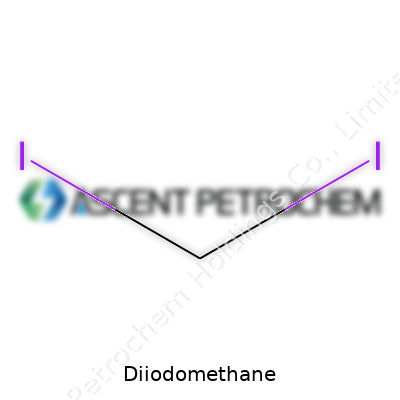
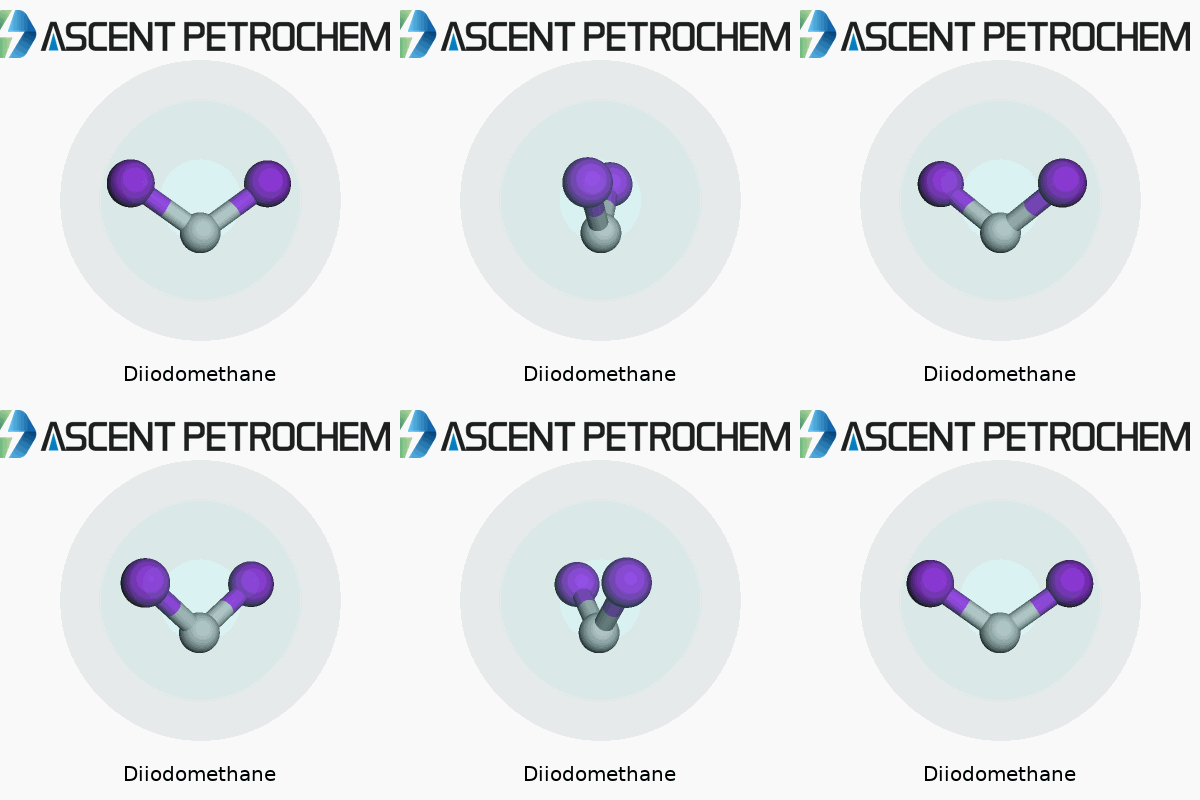
Diiodomethane might sound like something hidden on a dusty shelf at the back of a chemistry lab. Its chemical formula is CH2I2. Breaking that down, you get one carbon atom, two hydrogen atoms, and two iodine atoms. Not exactly the flashiest combination, but in chemistry, even the simplest arrangements can make a big impact.
Ask anyone who’s ever had to separate minerals under a microscope or check the refractive index of a gemstone – diiodomethane plays a bigger role than you might expect. Its high density and straightforward formula let scientists do things other liquids just can’t handle. For example, when you put tiny mineral grains into a drop of this liquid, the heavy ones sink and the light ones float. Suddenly, what seemed like a jumble becomes an organized sample. This step-by-step separation gives geologists a window into Earth's processes.
The carbon and hydrogen in the core of diiodomethane act as the backbone, not very exciting on their own. Once you swap out the usual chlorines or bromines found in related chemicals and bring in heavyweight iodine atoms, the liquid becomes dense enough for specialty work. Over time, scientists learned to trust this property for tasks like mineral identification and quality control in manufacturing. That kind of reliability makes a chemical more than just a formula; it turns it into a tool.
Talking about diiodomethane isn't complete without mentioning health and safety. Data shows repeated exposure can irritate eyes and skin. Long-term or careless use has sent more than a few to the hospital. People who work with it tend to share stories about headaches or worse when fume hoods malfunction. These aren't just cautionary tales; they’re reminders that every chemical formula needs respect–some more than others.
Chemistry teachers know hands-on experiments engage students best. Diiodomethane gives them a dramatic way to show density concepts in action. Watching grains of sand bob up or sink down creates a real “aha!” moment. All those memorable lessons come with reminders about gloves, goggles, and fresh air. Experience shows the right habits stick when woven into routine, not just posted as lab rules.
No one wants to lose a useful lab material, but safety and environmental concerns drive innovation. Alternative liquids like bromoform and specialized oils keep popping up, though they can’t always match diiodomethane’s winning mix of density and transparency. Some researchers look at tweaking molecules to build new, safer compounds with similar properties.
Scientists who care about clean air and healthy hands have shared workarounds. Tighter container seals cut down vapor leaks. Modern laboratories invest in better ventilation, and updated procedures keep everyone safe. Talking openly about risks and looking for green chemistry options brings a more responsible future to every science classroom and industrial lab.
In my own college days, watching those black and white sand grains part like the Red Sea in a drop of CH2I2 left a lasting impression. Small bottle, big lesson: chemistry’s real power shows up in both the big discoveries and the little bottles we treat with care.
Diiodomethane shows up in labs as a dense, clear liquid with interesting uses in science and industry. Chemists know it for its role in density experiments and as a heavy liquid for mineral separation. But its usefulness means little if people overlook how tricky it can get in storage. Fumes, stains, skin blisters, headaches—these issues all spring up with mishandling.
Common sense saves a lot of pain with diiodomethane. Bottles left sitting in the open welcome problems nobody wants. Diiodomethane decomposes fast when light or heat hit it. That breakdown releases iodine, which leaves nasty dark stains and a pungent smell. Fumes crawling through a room set off headaches and do worse with enough exposure. Skin picks up rashes and blisters faster than most realize, especially when gloves take a day off.
People say “store in a cool, dark place,” but this advice takes on real seriousness here. Stick diiodomethane in an amber bottle, not just any old jar. Clear glass invites sunlight, which pushes the chemical to fall apart. The color blocks those rays. A screw cap, tightly sealed, keeps out the oxygen, which also speeds decay. Tucking those bottles inside a chemical-safe cabinet away from sunlight—out of the daily shuffle—makes sense. Room temperature suits some substances, but diiodomethane does better somewhere a little chilly, away from laboratory heat and light sources. Anywhere the air runs dry keeps water at bay, fighting off more unwanted reactions.
People face bigger risks when they think, “one shelf fits all.” Diiodomethane doesn’t play well with metals, strong bases, or oxidizers. Set it near bottles of bleach or anything with a whiff of magic marker, and someone could walk into fumes or an ugly reaction. Storage rules from groups like OSHA and the ACS serve up lists of what works and what doesn’t. Taking thirty seconds to double-check those before shelving a new bottle never goes wasted.
Labels change everything. Print the name, date, hazard symbols, and a warning about light and heat. No one benefits when a faded marker leaves new lab staff guessing. Eye-catching tape or simple printed stickers make mistakes much less likely. Add “do not freeze”—since freezing bottles creates pressure, which cracks glass and brings costly cleanup.
Stockpiles in storerooms draw trouble. Buying more than what gets used in a year only creates old, degraded bottles. Regular inventory and checks, looking for color changes or weird smells, flag the ones that crossed the line from usable to unsafe. Yellow or brown liquid belongs in the hazardous waste bin—not back on the shelf. Waste isn’t a badge of shame. Tossing obsolete bottles early saves far more money than accident payouts or health bills.
Every new chemist or student should see a demo on safe storage. Watching someone carry out simple steps carries weight that memos and checklists don’t. Real stories about what “almost went wrong” or “how we learned the hard way” stick in memory. Firsthand knowledge grows into group safety habits that stick over time.
Too many stories end with a mess on the floor or a trip to the nurse because small steps were skipped. Keeping diiodomethane stable and safe sounds simple. In practice, it calls for slow, watchful routines and honest reminders: store it cold, keep it dry, shelter it from light, and always label the bottle so others know what they’re handling. This isn’t just about chemical bottles—it's about looking out for the next set of hands, and sometimes, even our own.
If you’ve ever worked in a classroom or a lab that does chemistry demos, you might remember diiodomethane as a tiny clear bottle with a heavy, colorless liquid inside. Scientists lean on it for simple but important reasons—it’s great for testing mineral densities. Diiodomethane, sometimes called methylene iodide, comes with a sweet, chloroform-like smell and sits on benches as a useful tool in geology and research labs.
Diiodomethane gets attention for the wrong reasons too. Skin contact leads to redness, itching, or even blistering. The fumes don’t give a free pass either—breathing them may irritate airways and spark headaches or dizziness. With higher doses, nausea and vomiting step in. Repeated exposure tells a tougher story, since reports link it to liver and kidney damage in lab animals.
I learned about the hazards early on, working as an undergraduate in a research lab with little safety training. A senior chemist showed up one day with skin rashes on his hand, thanks to a leaky glove and a rushed cleanup. He shrugged it off, but the lesson stuck: this isn’t something to wave off, even on a busy day. It highlights common pitfalls—careless handling, not swapping out gloves, and skipping extraction hoods—all reasons diiodomethane incidents still occur even among seasoned researchers.
Pouring leftover diiodomethane down the drain gives rise to bigger problems. This compound doesn’t break down easily in soil or water. Once in the environment, it lingers. Aquatic organisms can suffer, and diiodomethane makes the short list of chemicals that can act as moderate toxins for fish and plankton. Researchers at the US Geological Survey point toward its persistence as a risk, especially if it enters streams by accident.
The vapor is dense and can stick close to the ground after a spill. This heaviness makes simple spills a bigger problem in poorly ventilated areas, raising the risk not just inside, but outside the lab as well. Even a small mishap with a broken vial can turn into a bigger mess if clean-up guidelines aren’t followed.
Many labs now switch out diiodomethane for less toxic heavy liquids like sodium polytungstate or certain organic salts. These still allow students and geologists to measure densities without the same long-term health worries. Switching isn’t always easy, since nothing matches diiodomethane’s density and price quite so neatly. Still, the push to protect both health and the environment points in the direction of these alternatives.
Here’s a reality check: safe handling starts with good habits. Gloves and goggles alone don’t cut it unless used with fume hoods and regular training. I’ve watched departments improve safety records just by holding compulsory annual refreshers and making spill kits easy to find. Vendors labeling bottles with clear hazard warnings also helps prevent confusion among new lab members.
Regulatory guidance now encourages strict storage and smaller bottle sizes. Audit logs track usage. It’s not about eliminating diiodomethane outright; it’s about staying alert and respecting chemicals that rarely forgive mistakes. Clear communication, practical training, and investments in safer alternates reduce both health risks for workers and the impact on ecosystems.
Chemical safety always boils down to respecting the substances you use, staying informed, and working together to keep everyone—lab mates, students, and the environment—a lot safer.